


Abolition addressed to Brazil
- Normaler Preis
- €3.500,00 EUR
- Normaler Preis
-
- Verkaufspreis
- €3.500,00 EUR
- Grundpreis
- pro
After Thomas Clarkson (1760–1846). Portuguese abridgement attributed to Henry Koster (1793–1820).
Breve resumo sobre a natureza do Commercio de Escravatura e das atrocidades que d’elle resultam: seguido de huma relaçaõ historica dos debates que terminaram á final aboliçaõ.
Londres, impresso por Ellerton e Henderson, Johnson’s Court, Fleet Street, 1821.
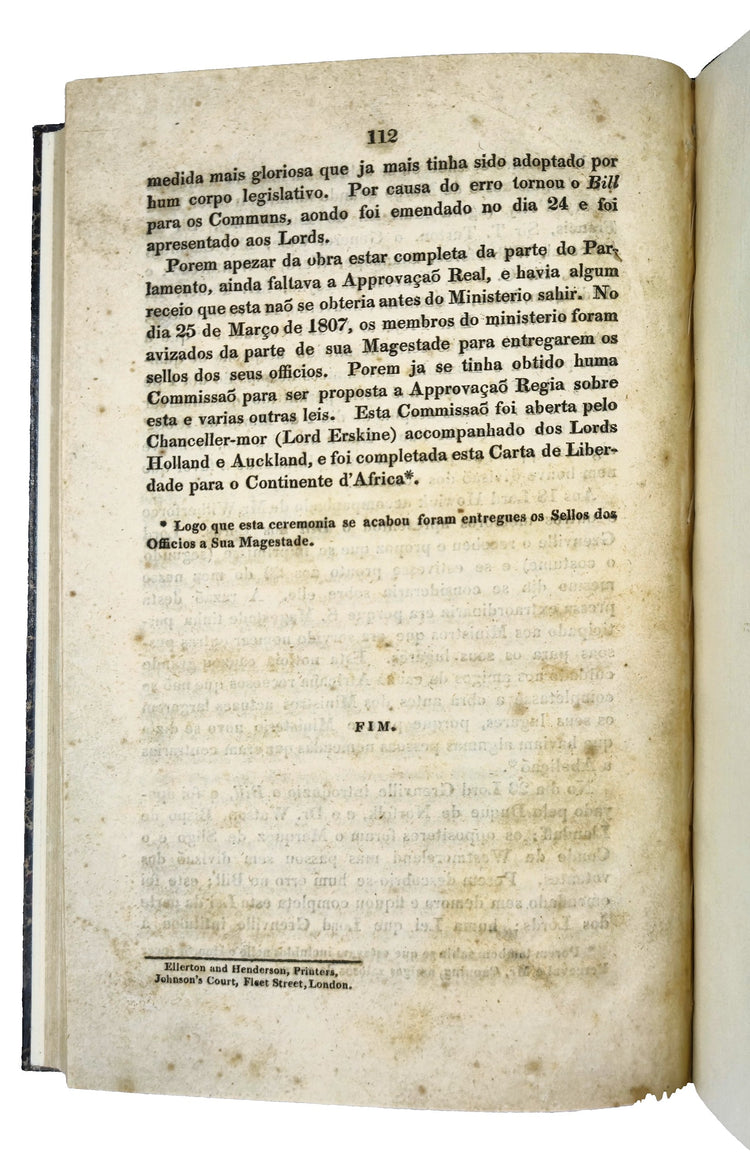
8vo (20 x 13 cm). xii, 112 pp., with a folding woodcut plate between the title and the preface. Closes with the printers’ English colophon, ‘Ellerton and Henderson, Printers, Johnson’s Court, Fleet Street, London.’
Later Bradel binding in half black straight-grain morocco with dark marbled paper boards. Smooth spine with paired gilt rules and the French title ‘Commerce des esclaves’.
First edition of a Portuguese appeal against the Atlantic slave trade, printed in London for circulation in Brazil on the eve of independence. The unsigned preface (pp. [iii]–iv) challenges two beliefs then current in Brazil. One held that Britain had suppressed the trade out of political and commercial self-interest. The other held that forcibly transporting Africans to the colonies improved their physical condition. The writers address their compatriots on behalf of people ‘de huma e outra cor’. Praising the sovereign and his ministers, they argue that abolition would benefit the ‘Imperio Portuguez e Brazileiro’.
The writers had planned to gather arguments specific to Brazil. Pressed for time, they issued what they had already ‘traduzido de outras obras’. The twenty-three chapters condense Clarkson’s two-volume history of the British abolition campaign. Chapter I follows his distinction between writers who attacked the trade directly, those who mentioned it in other works and those who spoke against it from positions of authority. On pp. 26–27, over dinner at Sir Charles Middleton’s house, Clarkson declares that he will devote his life to the cause. The Advertencia introduces the chapter summaries as a guide to the work of the ‘friends of the African cause’. The narrative follows the Quakers, Clarkson and Wilberforce up to the British abolition of the slave trade in 1807, the ‘final abolition’ of the title.
Robert Southey wrote to William Wilberforce in 1816 about Koster’s wish to dispel suspicions of British self-interest. On 22 January 1819 Southey described a Portuguese abridgement for circulation in Brazil. ‘The abridgement is made by Koster’, he wrote to Grosvenor Charles Bedford. On 28 March 1821 the African Institution reported that its Portuguese translation of an abridgement of Clarkson had been printed and was ready for distribution. The Society of Friends’ abolition committee helped fund printing and distribution.
The folding woodcut adapts the lower-deck plan of the Liverpool slave ship Brookes (also Brooks), figure IV in the London abolitionist broadside of 1789. It depicts 292 enslaved Africans. At the bow lie 124 men. Three of the 83 women lie lengthways between four rows of twenty. The Portuguese key groups the 85 children under ‘Quartos de Meninos’. Of these, 58 lie amidships and 27 at the stern, between two compartments still labelled ‘Store Room’ in English. The earlier Plymouth plan calls the corresponding compartment ‘Girls Room’.
Condition
Generally slightly toned and scattered brown spotting. The woodcut, heading and key are fully visible, with vertical folds and light spotting in the margins.
Provenance
Bibliothèque Claude Mozis.
Reference
African Institution. Fifteenth Report of the Directors of the African Institution, Read at the Annual General Meeting, Held on the 28th Day of March, 1821. London, printed by Ellerton and Henderson, 1821, p. 27. Internet Archive, archive.org/details/ASPC0002428500/page/27/mode/1up.
“Breve resumo sobre a natureza do commercio de escravatura e das atrocidades que d’elle resultam.” European Political Cultures of Anti-Slavery, EURESCL and CIRESC, record 83.
Clarkson, Thomas. The History of the Rise, Progress, and Accomplishment of the Abolition of the African Slave-Trade by the British Parliament. Vol. 1, London, Longman, Hurst, Rees, and Orme, 1808, ch. 2, pp. 32–33.
Klein, Lauren, et al. “Every Datapoint a Person: Description of a Slave Ship.” Data by Design, public beta, Emory Digital Humanities Lab, 2023, data-by-design.vercel.app/chapters/description.
London Committee of the Society for Effecting the Abolition of the Slave Trade. Description of a Slave Ship. London, printed by James Phillips, 1789, fig. IV. Princeton University Library. JSTOR, www.jstor.org/stable/community.34338776.
Pinheiro, Ana Virginia. “Às vésperas dos 200 anos da Biblioteca Nacional.” Revista África e Africanidades, ano 3, no. 11, Nov. 2010, figs. 2–7, africaeafricanidades.com.br/documentos/01112010_31.pdf.
Southey, Robert. Letter to Grosvenor Charles Bedford. 22 [Jan.] 1819. Bodleian Library, MS Eng. Lett. d. 47. The Collected Letters of Robert Southey, edited by Ian Packer and Lynda Pratt, pt. 6, Romantic Circles, 2017, letter 3234.
Southey, Robert. Letter to William Wilberforce. 30 Nov. 1816. The Collected Letters of Robert Southey, edited by Tim Fulford et al., pt. 5, Romantic Circles, 2016, letter 2870.
Verfügbarkeit für Abholungen konnte nicht geladen werden
Teilen


Kontakt
E-Mail: hugo@artemrarebooks.com
Telefon: +31651042297
Besuche nach Vereinbarung
Ehemalige US-Botschaft
Lange Voorhout 102
2514EJ
Den Haag (Niederlande)
Versandadresse
Nannie van Wehlstraat 51
2548MN
Den Haag
Niederlande