


1711 Ottoman Arabic manuscript on heirs, shares, and Islamic inheritance law
- Regular price
- €2.500,00 EUR
- Regular price
-
- Sale price
- €2.500,00 EUR
- Unit price
- per
RESERVED
al-Sajāwandī [Sirāj al-Milla Muḥammad b. ʿAbd al-Rashīd al-Sajāwandī; dates unknown].
al-Sirājiyya fī al-farāʾiḍ.
Ottoman lands, completed in 1123 AH / 1711 CE.
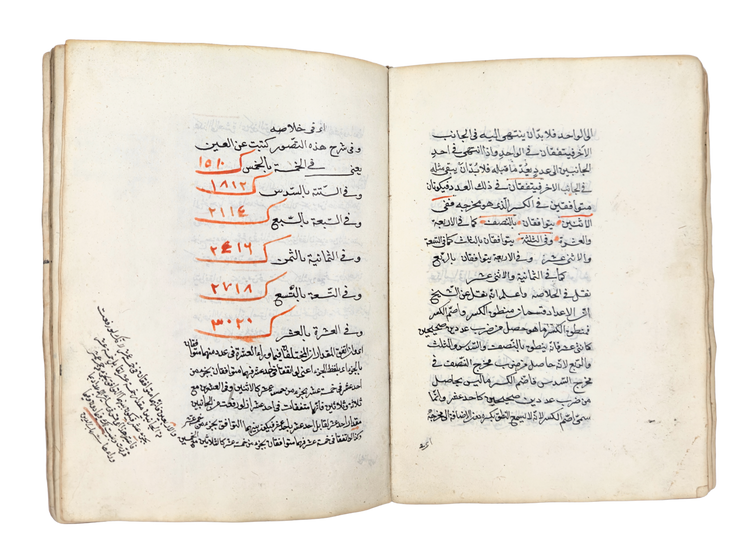
8° (20 x 14,5 cm), Arabic manuscript on paper. 120 leaves. Arabic text in black ink with red rubrication, red overlining, and frequent red textual markers. Approximately 17 lines per page. Opening two pages written within ruled frames with gilt and coloured bands, red separators, and gold roundel markers; later leaves in red-ruled panels, followed by plainer unframed pages. Numerous marginal notes, corrections, inheritance calculations, and small schematic diagrams throughout.
Bound in brown morocco over boards, with blind-ruled decoration, worn from use.
A dated Ottoman scholarly manuscript of al-Sirājiyya fī al-farāʾiḍ, one of the best-known Hanafi texts on the Islamic law of inheritance. The work explains the formal division of estates among heirs: children, parents, spouses, siblings, agnatic relatives, and other legally recognized claimants. It was made for practical legal study, not display alone. The margins preserve the traces of use by later readers: glosses, corrections, fractional calculations, and small inheritance diagrams showing how shares were to be distributed.
The decorated opening gives the author as سراج الملّة محمد بن عبد الرشيد السجاوندي — Sirāj al-Milla Muḥammad b. ʿAbd al-Rashīd al-Sajāwandī. The text opens with the basmala, followed by praise of God and the Prophet, and then a traditional saying urging the study and teaching of the laws of inheritance, “for they are half of knowledge.” This opening is especially appropriate for a manual of farāʾiḍ, the technical discipline of inheritance law.
The first opening is attractively presented, with a large black basmala set within a decorated panel of gilt, green, red, and orange bands. The facing page continues in a matching framed layout. Thereafter the manuscript gradually becomes more utilitarian: the early leaves retain red ruled frames, while later leaves are plainer, with red ink used mainly for headings, emphasis, and textual division. This changing presentation reinforces the character of the manuscript as a working legal textbook.
The text remains consistent throughout as a manual of inheritance law, discussing the distribution of shares, exclusions and substitutions among heirs, corrections of inheritance calculations, and family-relationship cases involving parents, children, spouses, siblings, and more distant relatives. Several margins contain worked numerical examples and small schematic share tables, showing that the manuscript was actively consulted and studied. The colophon is preserved and dates the copy to 1123 AH / 1711 CE.
The preliminary blanks preserve additional later paratext. These include a large Arabic title inscription, Ottoman Turkish notes, and later ownership or reading annotations. One Ottoman Turkish note appears to refer to visiting a sacred relic or site in Egypt; another seems to be a short moral or devotional maxim. These notes are not central to the identification of the text, but they add to the manuscript’s history of use and circulation.
Condition: binding slightly rubbed, worn at the top of spine. First quire partially loose at the gutter, with exposed sewing; leaves with recurring upper-margin dampstaining, occasional wear. Text generally bright and well legible.
Couldn't load pickup availability
Share


Contact
Email: hugo@artemrarebooks.com
Phone: +31651042297
Visit us on appointment at:
Former US Embassy
Lange Voorhout 102
2514EJ
The Hague (The Netherlands)
Shipping address:
Nannie van Wehlstraat 51
2548MN
The Hague
The Netherlands