


A 1602–3 Ottoman Manuscript on Arabic Morphology
- Regular price
- €3.800,00 EUR
- Regular price
-
- Sale price
- €3.800,00 EUR
- Unit price
- per
ʿAbd Allāh b. Muḥammad, known as Naqra-kār [attributed.]
Sharḥ al-Shāfiya.
Ottoman lands, probably Anatolia, main section completed in Shawwāl 1011 AH / March–April 1603 CE; opening section later supplied, perhaps 18th century.
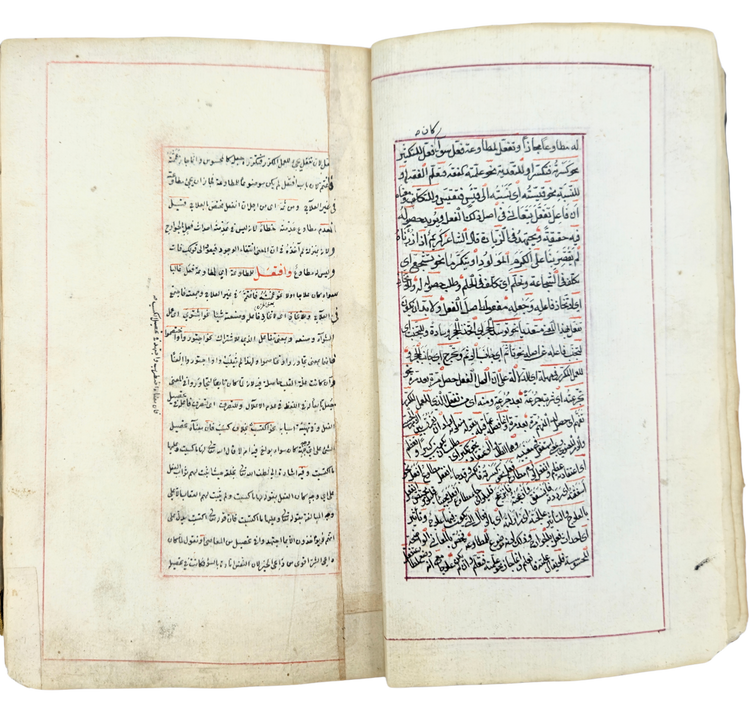
8°, ca. 20 x 12 cm. Arabic manuscript on European paper. Composite codex of 173 leaves: the first 24 leaves supplied in a later, larger naskh hand, followed by 149 leaves in an earlier, smaller Ottoman naskh hand. Text in black ink, with red rubrication, red overlining, and frequent red textual markers; mostly 19 lines per page. The opening leaves are more formally presented, with gilt framing to the first leaves; the remaining text is written within red-ruled panels. Numerous marginal and interlinear glosses throughout, in several hands, showing sustained scholarly use.
Bound in a dark brown Islamic-style leather binding with fore-edge flap, gilt-ruled borders, and a gilt stamped central medallion with radiating finials; the flap bears a matching gilt medallion. Pink paper pastedowns, with later repairs and a modern French bibliographical note pasted to the front pastedown.
A substantial Ottoman scholarly manuscript of Naqra-kār’s commentary on Ibn al-Ḥājib’s al-Shāfiya, one of the central works of the Arabic grammatical curriculum and among the most important pre-modern texts for the study of ṣarf, or Arabic morphology. The manuscript preserves a densely written teaching copy of a technical commentary concerned with the internal structure of Arabic words: roots and derived forms, verbal and nominal patterns, inflectional changes, weak letters, substitutions, assimilations, elisions, and the formal rules by which Arabic words are generated and transformed.
Unlike works on syntax, which examine the arrangement of words in sentences, al-Shāfiya addresses the architecture of the word itself. It explains how meaning is produced through pattern, augmentation, contraction, phonetic change, and grammatical derivation. For this reason, the work occupied an important place in the Ottoman madrasa curriculum, where mastery of Arabic morphology was essential for the advanced study of law, theology, rhetoric, Qurʾanic commentary, and the classical Arabic sciences.
The present codex is especially notable as a composite but early scholarly copy. The main section was completed in Shawwāl 1011 AH / March–April 1603 CE, while the opening twenty-four leaves were supplied later, probably in 1744–45. The contrast between the two hands records the manuscript’s continued use and preservation over time. Numerous marginal and interlinear glosses, corrections, and explanatory notes show that the volume was not merely copied for storage or display, but actively read, taught from, and studied by successive owners and students.
There are several ownership and paratextual notes. A clear ownership inscription reads: تملكه العبد الفقير إلى ربه الغني الشيخ خيري حيدر الكردي سنة ١١٥٧, “Owned by the poor servant, in need of his rich Lord, al-Shaykh Khayrī Ḥaydar al-Kurdī, year 1157 AH.” This corresponds to 1744–45 CE and may relate to the later phase in which the opening leaves were supplied or the volume repaired. A small seal impression is present below the inscription, but is worn. Additional title and price notes occur on the endleaves and fore-edge, including references to Sharḥ al-Shāfiya.
Condition: Binding rubbed, spine damaged, flap barely holding. End-leaves with some soiling, wear and staining. Slight worming in the blank margins of the last ca. 20 leaves and slight browing. Otherwise contents in good condition.
Couldn't load pickup availability
Share


Contact
Email: hugo@artemrarebooks.com
Phone: +31651042297
Visit us on appointment at:
Former US Embassy
Lange Voorhout 102
2514EJ
The Hague (The Netherlands)
Shipping address:
Nannie van Wehlstraat 51
2548MN
The Hague
The Netherlands