


A 1638 Ottoman manuscript on the art of Arabic eloquence
- Regular price
- €2.200,00 EUR
- Regular price
-
- Sale price
- €2.200,00 EUR
- Unit price
- per
“al-Khaṭāʾī” [Niẓām al-Dīn ʿUthmān al-Khaṭāʾī, attributed; dates unknown, active by 1048 AH / 1638 CE].
Ḥāshiyat al-Khaṭāʾī ʿalā al-Mukhtaṣar.
Ottoman lands, probably Anatolia, completed Jumādā al-Ākhira 1048 AH / October–November 1638 CE.
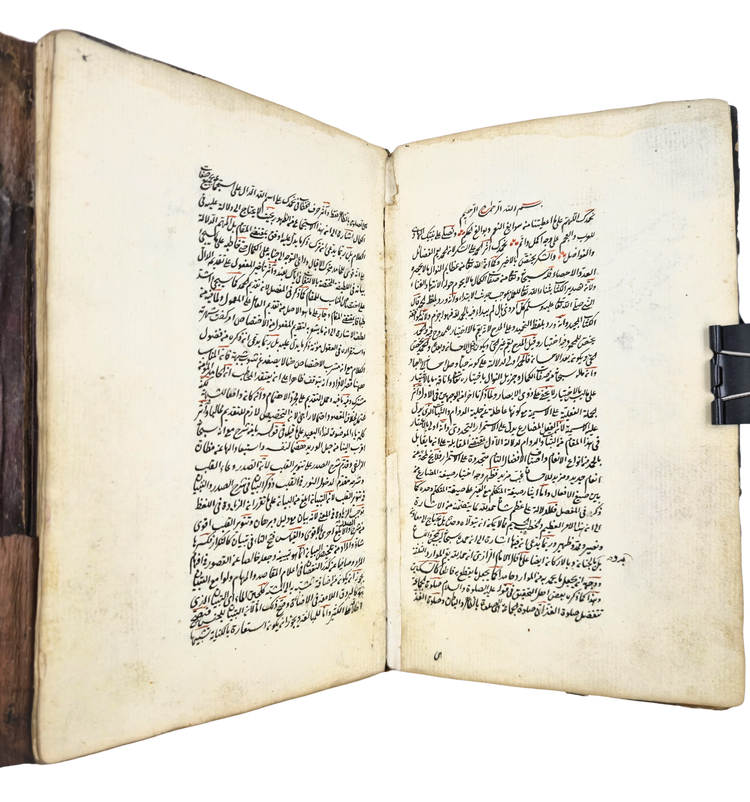
8° (20 x 12,5 cm), Arabic manuscript on paper. 48 extant leaves, foliated 2–49. Arabic text in black ink with red rubrication, red overlining, and frequent red textual markers. Approximately 25 lines per page. Catchwords in the lower margins.
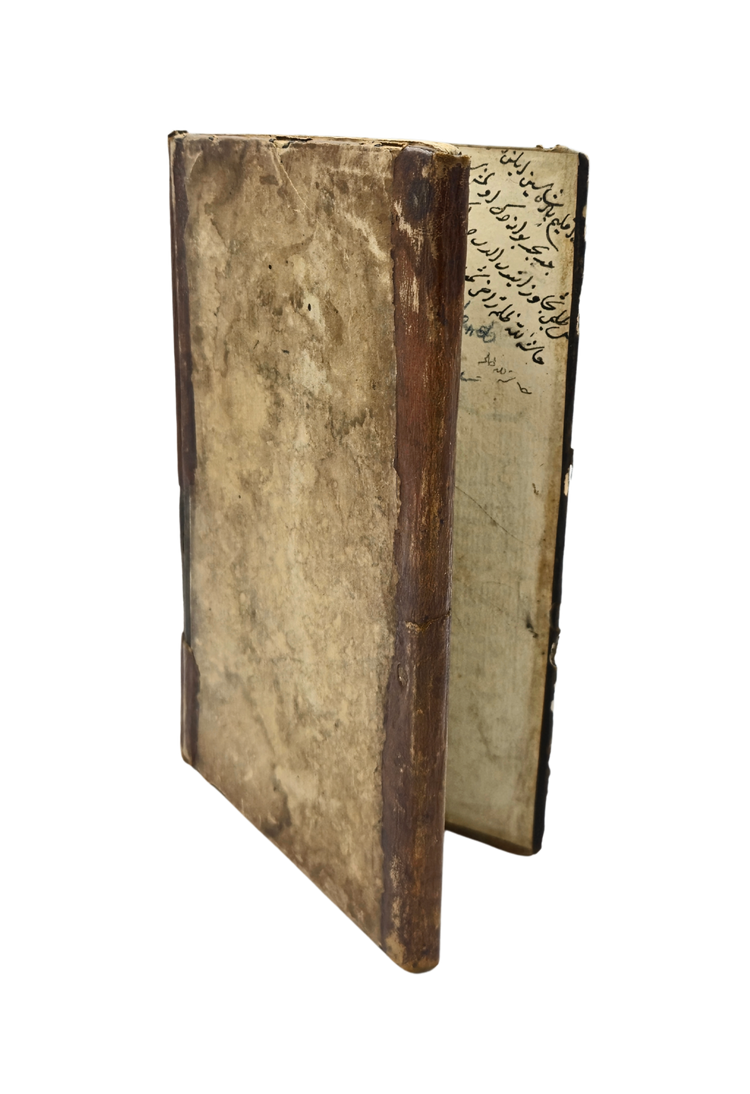
Bound in an Islamic-style binding, probably Ottoman or later, with mottled tan paper-covered boards, dark brown leather spine and edge reinforcements, and a preserved fore-edge flap.
A dated Ottoman scholarly manuscript on Arabic rhetoric, copied in 1048 AH / 1638 CE. The manuscript preserves al-Khaṭāʾī’s commentary on one of the most important Arabic rhetoric textbooks used in Ottoman higher education: al-Taftāzānī’s al-Mukhtaṣar, better known as Mukhtaṣar al-Maʿānī. This was an advanced teaching text, studied in the madrasa curriculum for the formal analysis of eloquence, meaning, style, and argument in Arabic.
The copy was clearly made for serious scholarly use: it is densely written, carefully marked in red, and structured around short quoted lemmata followed by explanation. Although the foliation begins with the number 2, the text itself appears complete at the beginning, opening normally with the basmala and introductory praise. The manuscript is especially interesting because it preserves its dated colophon, repeated title notes, ownership inscriptions, seal impressions, and later European notes attempting to identify the text. The manuscript is repeatedly identified on the endleaves as خطائي على المختصر (Khaṭāʾī ʿalā al-Mukhtaṣar) and in longer notes as a ḥāshiya on Mukhtaṣar al-Maʿānī.
The final colophon is preserved and dates the completion of the manuscript to Jumādā al-Ākhira 1048 AH. The closing lines read in part: فتمّ بحمد الله الملك الوهاب ... وقت العصر يوم الأحد / في شهر جمادى الآخرة سنة ثمان وأربعين وألف — “Completed, praise be to God, the Generous King ... at the time of ʿaṣr on Sunday, in the month of Jumādā al-Ākhira, in the year one thousand and forty-eight.” No place of copying is securely visible in the colophon; on present evidence, the safest localization is Ottoman lands, probably Anatolia.
The endleaves preserve substantial later paratext: repeated Arabic title inscriptions, ownership notes, rubbed seal impressions, and later European catalogue annotations. One ownership inscription appears to record the manuscript among the books of Ḥusayn b. Darwīsh, followed by a pious supplication. Several seal impressions are present, including small circular and larger rubbed impressions. A later French pencil note identifies “Hataï” and appears to associate the name with Shah Ismāʿīl Ṣafavī, almost certainly a later confusion caused by the shared name or pen-name Khaṭāʾī. The Arabic title notes and the text itself identify the manuscript not as a poetic work by Shah Ismāʿīl, but as al-Khaṭāʾī’s ḥāshiya on al-Mukhtaṣar.
Condition:
Binding worn but intact. Endleaves heavily used, with dampstaining, smudging and owners’ inscriptions. Text leaves generally very good and bright, well legible, though a few pages toned. Damp stain on the top 1/5 of the last ten leaves. Possibly lacking an initial preliminary or title leaf, though the main text appears to begin complete with the basmala.
Couldn't load pickup availability
Share


Contact
Email: hugo@artemrarebooks.com
Phone: +31651042297
Visit us on appointment at:
Former US Embassy
Lange Voorhout 102
2514EJ
The Hague (The Netherlands)
Shipping address:
Nannie van Wehlstraat 51
2548MN
The Hague
The Netherlands