


A 1674–75 Ottoman Turkish Tuḥfat al-Ḥaramayn, predating Nābī’s pilgrimage account
- Regular price
- €4.500,00 EUR
- Regular price
-
- Sale price
- €4.500,00 EUR
- Unit price
- per
RESERVED
al-Ḥājj Muḥammad Efendi [scribe]; [Yūsuf Nābī Efendi, 1052–1124 AH / 1642–1712 CE (?)].
Tuḥfat al-Ḥaramayn.
Ottoman lands, place not stated, colophon dated 1085 AH / 1674–75 CE.
Ottoman Turkish manuscript on European watermarked paper (ca. 21,5 x 16,5 cm). 73 leaves, text in black ink, mostly 19 lines per page, in a neat Turkish naskh hand, with catchwords.
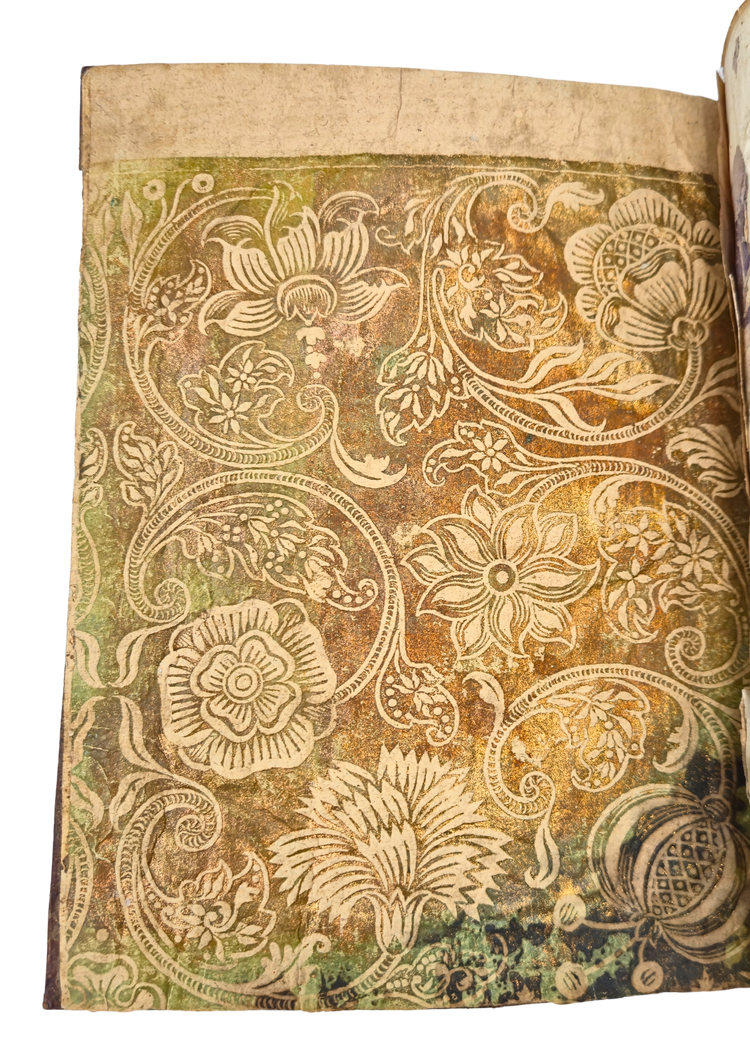
Bound in a probably contemporary or early Ottoman-style brown leather binding, covers blind-tooled with ruled panels and small rosette/star stamps, with writing on foot-edge and decorative gilt floral paper pastedowns.
An Ottoman Turkish manuscript of Tuḥfat al-Ḥaramayn, “The Gift of the Two Sanctuaries,” a literary and devotional text on the holy places of Mecca and Medina, best known in Ottoman Turkish literary history as Yūsuf Nābī’s famous hajj narrative of 1089–90 AH / 1678–79 CE. The present manuscript, however, is clearly dated in the colophon to 1085 AH / 1674–75 CE and names the scribe as al-Ḥājj Muḥammad Efendi, kātib-i waqf.
If this is Nābī’s text, the date makes the manuscript exceptionally early and raises a significant chronological question for the manuscript tradition. If it is not Nābī’s text, it remains an early Ottoman Turkish Ḥaramayn manuscript bearing the same title, later associated with Nābī’s more famous work. In either case, the manuscript is of considerable interest for the textual and devotional culture of Ottoman pilgrimage literature.
The title Tuḥfat al-Ḥaramayn is stated in the front, the colophon and the fore-edge. Later French bibliographical notes on the front pastedown and on a loose inserted slip identify the manuscript as a copy of Nābī’s celebrated pilgrimage account, however in the manuscript there is no clear internal authorial statement naming Yūsuf Nābī.
The text opens with an ornate religious and moral introduction in Ottoman Turkish, invoking God, the Prophet, forgiveness, devotion, and the spiritual merit of pilgrimage. Later sections move into the main Ḥaramayn material, with descriptions of the Kaʿba, Bayt al-Ḥarām, ṭawāf, Ṣafā and Marwa, gates, stations, sacred architecture, and rites of visitation. Near the end the text includes farewell and salām passages, giving the manuscript the character of both a travel account and a devotional guide to the holy places.
The preliminary leaves preserve additional traces of ownership and later study, including a black oval seal apparently reading ʿAbd al-Qādir and a longer Ottoman Turkish ownership or warning note.
Condition: tear in spine, binding creased and slightly rubbed but otherwise good. Structurally fragile, with exposed sewing, split gutters, and loose or loosening gatherings. Endleaves and outer leaves stained, creased, torn, and partly detached, with losses near the gutter and edges. Main text generally well legible despite dampstaining, soiling, smudging, edge wear, and occasional offsetting.
Couldn't load pickup availability
Share


Contact
Email: hugo@artemrarebooks.com
Phone: +31651042297
Visit us on appointment at:
Former US Embassy
Lange Voorhout 102
2514EJ
The Hague (The Netherlands)
Shipping address:
Nannie van Wehlstraat 51
2548MN
The Hague
The Netherlands