


A princess and her wife in Spanish verse
- Regular price
- €2.800,00 EUR
- Regular price
-
- Sale price
- €2.800,00 EUR
- Unit price
- per
Pedro Navarro.
El casamiento entre dos damas. Primera [y segunda] parte.
Seville, Viuda de Vázquez y Compañía, 1816.
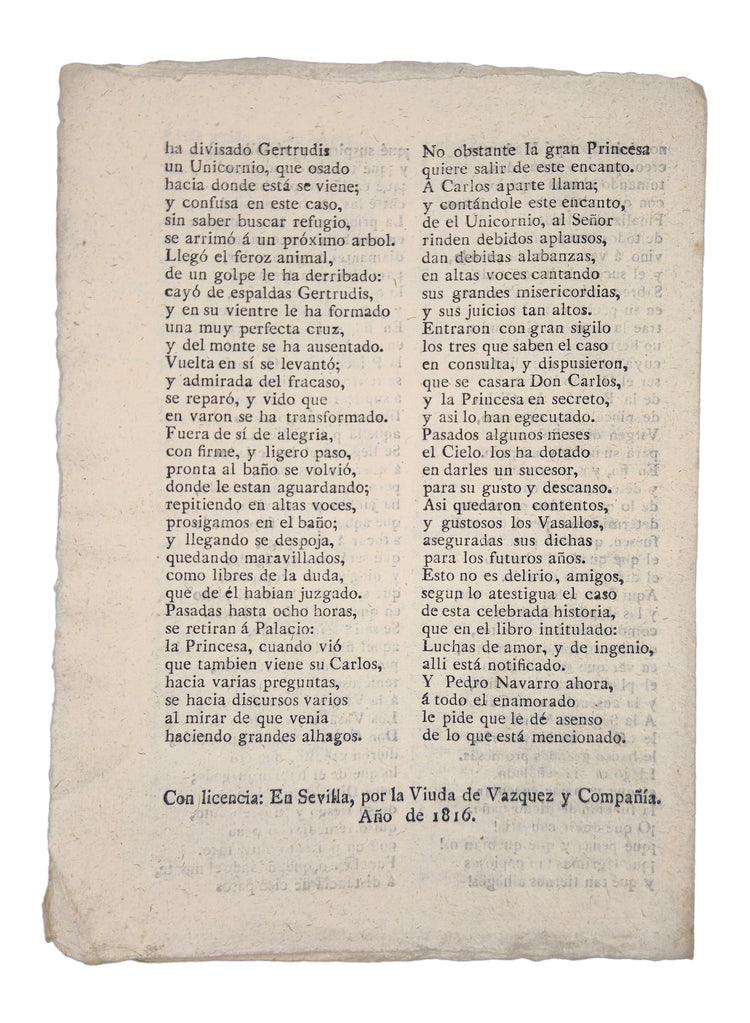
Quarto, ca. 21 x 16 cm. Two unbound bifolia, [4] + [4] pp., complete. Text in two columns, with a woodcut and a dated colophon in each part. Part I is numbered ‘Núm. 10’.
An illustrated Spanish verse romance in which a woman from Vienna marries a Greek princess. Doña Gertrudis leaves home to search for her lover, dressing as a student in her brother’s clothes. In Greece she enters the service of the chief secretary of the royal household under the name Don Carlos. The princess falls in love with Carlos, and her father orders them to marry.
On their wedding night Gertrudis tells the princess that she is a woman. Her bride replies ‘haremos vida gustosa’ (‘we shall live happily together’) and chooses to continue their marriage in secret. They live as spouses for years, a period of shared happiness that is central to Pablo Restrepo Gautier’s queer reading of the romance. The absence of an heir and the fact that Carlos still has no beard arouse suspicion at court, prompting a series of tests that culminates in a bath. Gertrudis flees before it can take place. A unicorn traces a cross on her abdomen, miraculously transforming her into a man. The couple marry again in secret and eventually have an heir.
The two parts were issued as pliegos de cordel, inexpensive verse pamphlets. The same woodcut of a couple joining hands before a cleric appears above both titles. Navarro names himself in the closing verses and cites Luchas de amor y de ingenio as his authority for the story.
The romance is known in at least nineteen editions printed between about 1750 and 1874. Martínez Sariego, who uses this Seville edition in her study, also records a consignment of 323 copies of the romance bound for Buenos Aires and seized in Montevideo in 1815.
Provenance. El Remate, Madrid, sale 273, 24 September 2026, lot 1525.
Condition
Light uneven toning, scattered spots and some marginal soiling. Creasing at the edges and corners, most pronounced at the lower outer corner of Part II. Show-through from the reverse. Text and woodcuts clear.
References
Universidad de Sevilla, Biblioteca de Humanidades, Fondo Hazañas, H Ca.029/212. Digitised copy. Mapping Pliegos 7848.
Mónica María Martínez Sariego, “Del canard al pliego de cordel: el motivo del matrimonio entre mujeres y su resolución simbólica en la literatura popular impresa”, Creneida 13 (2025), pp. 41–68, especially pp. 53–59. Journal article.
Pablo Restrepo Gautier, “El casamiento entre dos damas by Pedro de Navarro: Finding the Joys of Non-heteronormativity in the Shadows of an Early Modern Spanish Romance”, in Bodies beyond Labels: Finding Joy in the Shadows of Imperial Spain, ed. Daniel Holcombe and Frederick A. de Armas, pp. 138–156. Toronto, University of Toronto Press, 2024. JSTOR.
Couldn't load pickup availability
Share


Contact
Email: hugo@artemrarebooks.com
Phone: +31651042297
Visit us on appointment at:
Former US Embassy
Lange Voorhout 102
2514EJ
The Hague (The Netherlands)
Shipping address:
Nannie van Wehlstraat 51
2548MN
The Hague
The Netherlands