

A rare depiction of one of the most important slaving centers
- Regular price
- €8.500,00 EUR
- Regular price
-
- Sale price
- €8.500,00 EUR
- Unit price
- per
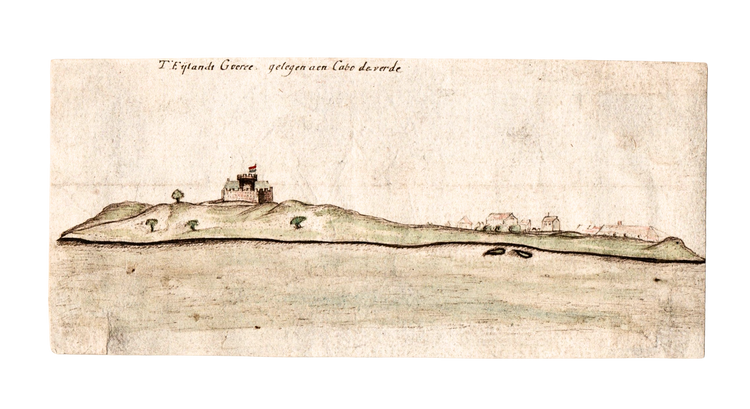
T eijlandt Goeree. Gelegen aen Cabo de-Verde.
Gorée Island (Bir or Beseguiche, Senegal), ca. 1640-1677.
Pencil, pen and black ink, with watercolour, on paper with unidentified watermark; inscribed along the upper edge. 7,5 × 16,7 cm.
A rare depiction of a key early hub in the development of the Atlantic slave trade, drawn from direct observation. The small island of Gorée, shown here under its Dutch name Goeree (Goede Reede, “good anchorage”), lies in the bay of present-day Dakar in Senegal. Its position—easily defensible and close to the mainland—made it highly desirable. Seized by the Dutch in the late 1500’s, the island was developed with two forts and quickly became a key base in the European-led forced transportation of African people to the Americas. Owing to its location at the westernmost point of Africa, it functioned as an essential hub for trade along the entire West African coast. By the early seventeenth century, it had already become one of the most important Dutch slaving centers on the West African coast.
The present view shows the island from the south-east, with its sheltered bay at the center, Fort Nassau on the southern height, Fort Oranje on the northern side, and a small settlement in between. The Dutch flag is prominently raised above Fort Nassau. While the composition appears to provide a clear overview, closer examination reveals that the artist has adopted a notably low and impractical vantage point. This limits the visibility of Fort Oranje, which is only partially shown. Such a viewpoint would be unlikely in a composed or derivative image, where clarity and completeness would normally be prioritised. Indeed, other seventeenth-century depictions from the same angle consistently adopt a higher viewpoint to show Fort Oranje in full. A further indication of direct observation is the inclusion of a roof-like structure behind the tower of Fort Nassau. This detail is absent from most other representations and appears only in a drawing by Johannes Vingboons from the opposite side of the island.
Unlike the carefully composed works by Vingboons, the present sheet functions as an exploratory field sketch. Its low, uncorrected viewpoint and inclusion of incidental detail demonstrate that it was drawn from life rather than copied or constructed. As an apparently firsthand record from the early seventeenth century, it offers a rare and immediate insight into a site of immense historical consequence.
Condition: two small closed tears at the foot edge, paper a little soiled. Leaf casting repairs at the back.
Bibliography
Den Heijer, Henk. The Dutch West India Company, 1621–1791. Brill, 2013.
Ribeiro da Silva, Filipa. Dutch and Portuguese in Western Africa: Empires, Merchants and the Atlantic System, 1580–1674. Brill, 2011.
Thilmans, Guy. Histoire militaire de Gorée. Université Cheikh Anta Diop, 2006.
Couldn't load pickup availability
Share
Contact
Email: hugo@artemrarebooks.com
Phone: +31651042297
Visit us on appointment at:
Former US Embassy
Lange Voorhout 102
2514EJ
The Hague (The Netherlands)
Shipping address:
Nannie van Wehlstraat 51
2548MN
The Hague
The Netherlands