


An early scientific survey of Saint-Domingue, with important observations on Taíno and Creole culture
- Regular price
- €5.000,00 EUR
- Regular price
-
- Sale price
- €5.000,00 EUR
- Unit price
- per
“Pere” Jean-Barthélemy-Maximilien Nicolson (1734–c. 1790).
Essai sur l’histoire naturelle de l’Isle de Saint-Domingue.
Paris, Gobreau, 1776 [Colophon: De l'Imprimerie d'Antoine Boudet, imprimeur du Roi].
8° (21 x 13,5 cm). [2], XXXI, [1], 374, [2] pp. With an engraved title-page and 10 engraved botanical and zoological plates.
Contemporary green stiff paste-paper boards with handwritten title label on the spine, pages wholly untrimmed.
First edition of this important early scientific and descriptive survey of French colonial Haiti and, more broadly, the island of Hispaniola.
Although the main focus of the book is natural history, his account constitutes an important contemporary source for the social history of eighteenth-century Saint-Domingue. Nicolson’s perspective remains that of a European cleric writing within colonial society, but his descriptions of the condition of enslaved people are notably critical. On p. 54 he writes: “Nothing is worse than their situation. We see most Black people languish in extreme poverty.”
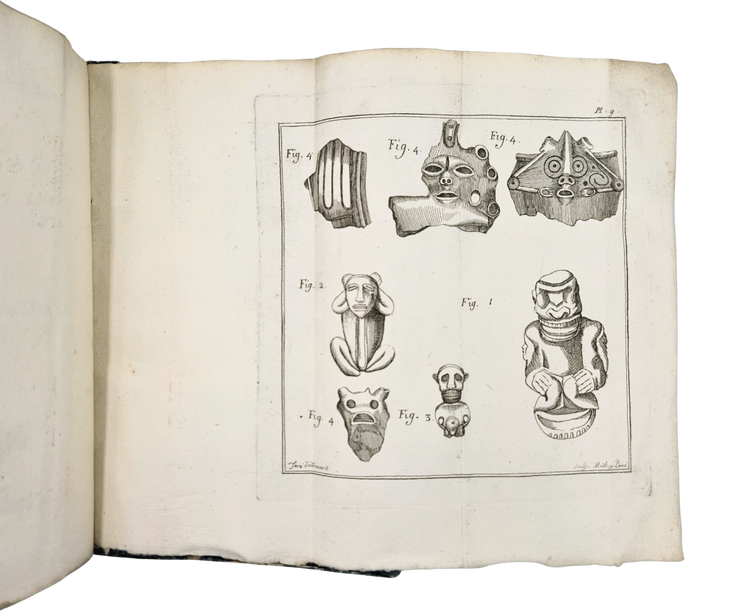
The closing pages, 365–371, contain a valuable discussion of Taíno history and material culture. Nicolson describes ritual objects, fragments of pottery and stone axes, several of which are represented in the plates. He explicitly laments the destruction wrought by the European conquest: “Everything was annihilated with them; their conquerors sought only gold and concerned themselves solely with obtaining it” (p. 365).
The main Essai on natural history is remarkably wide-ranging. Approximately 200 pages are devoted to the plant kingdom, with roughly four hundred plants discussed according to their local Creole names, characteristics, occurrence, practical uses and medicinal properties. Nicolson also describes marine life, insects, crustaceans and other elements of the island’s fauna, together with its climate, geography, population, government and economic prospects.
Particular attention is given to economically important plants and to the cultivation and processing of coffee, sugar cane, indigo, tobacco and cotton. These descriptions carry the work well beyond conventional botany: they offer detailed evidence of agricultural practice, plantation production and the enslaved labour upon which the prosperity of the colony depended.
The work also records the devastating earthquake of 1770. Nicolson describes the plantation district of the Cul-de-Sac, outside Port-au-Prince, as almost unrecognisable on the following morning. On several plantations, he writes, the earth had opened “as if a plough had passed through it.”
The ten folding copperplates illustrate flowers and other plants, insects, crustaceans and Taíno artefacts. Together with the engraved title, they form a particularly appealing early visual record of the natural and cultural history of Hispaniola.
The author’s name does not appear on the title-page and is given only in the Approbation on p. 374, where he is identified as “le P. Nicolson.” A Dominican priest and naturalist, Nicolson spent four years in Saint-Domingue, serving as Apostolic Prefect of the Dominicans and as Superior at Léogâne from 1769 to 1773. His observations were gathered during extensive journeys through the colony.
A scarce and significant work on the (ancient) history of Haiti, the Dominican Republic, Caribbean natural history, colonial agriculture and slavery.
Condition: binding lightly rubbed and final leaves slightly dust-soiled. Otherwise a good, unsophisticated copy, preserved as issued in its original paste-paper boards and with its untrimmed edges intact.
Literature: Bradley I, p. 334; Nissen, ZBI 2973; Pritzel 6695; Sabin 55259; Stafleu & Cowan 6787.
Couldn't load pickup availability
Share


Contact
Email: hugo@artemrarebooks.com
Phone: +31651042297
Visit us on appointment at:
Former US Embassy
Lange Voorhout 102
2514EJ
The Hague (The Netherlands)
Shipping address:
Nannie van Wehlstraat 51
2548MN
The Hague
The Netherlands