

An exceptionally rare example of Herreyns’s highly individual etched style
- Regular price
- €2.500,00 EUR
- Regular price
-
- Sale price
- €2.500,00 EUR
- Unit price
- per
Daniël Herreyns (1678–1731)
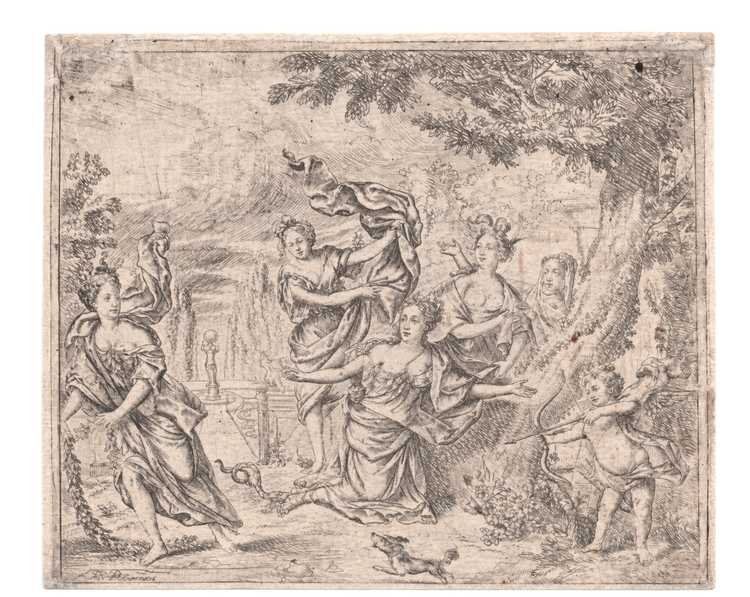
The Death of Eurydice
Antwerp, c. 1700.
Etching on paper, plate 149 × 167 mm; sheet 153 × 172 mm. Signed in the plate at lower left: D. Herreyns. Hollstein 1.
An exceptionally rare work by a little-known Antwerp printmaker with a curious style, of whom only five etchings are recorded in Hollstein. Older artist lexica already characterised Herreyns’s prints as rare, and they remain almost entirely absent from major public collections. We have traced only one other impression of the present composition in an institutional collection, in the Rijksmuseum, Amsterdam (inv. RP-P-OB-55.381); no print by this Daniël Herreyns appears in the British Museum’s online collection catalogue.
Herreyns’s highly individual style is immediately apparent. His elongated, almost doll-like figures have small oval heads, large eyes and expressive but anatomically awkward gestures. Billowing garments break into sharp, restless folds, while rapidly drawn lines and irregular passages of cross-hatching create a lively surface rather than smooth modelling. The shallow, crowded composition resembles a stage on which the reactions of Eurydice and the four nymphs unfold as an elaborate choreography. At the centre, Eurydice collapses as a snake bites her foot, while Cupid draws his bow against the serpent. This unusual combination of lingering Antwerp Mannerism and Baroque movement—elegant, theatrical and slightly strange—recurs in Herreyns’s other known etchings and gives his small oeuvre a remarkably recognisable character.
The attribution and dating adopted here follow Hollstein. Wurzbach and Thieme–Becker, followed in the present Rijksmuseum cataloguing, instead assign the five etchings signed D. Herreyns to an older Daniël Herreyns, documented in Antwerp between 1643 and 1678. The conspicuously archaic character of the style is compatible with this earlier attribution but cannot by itself resolve the identity of the printmaker; no modern study appears to have examined the question conclusively.
Condition: A clear impression with narrow margins around the platemark. The sheet is lightly soiled and unevenly toned, with scattered foxing and staining, including rust-brown marks at centre right and a small dark spot near the upper-right corner. The upper corners have been repaired, with minor wear and small abrasions along the edges. Two collectors’ marks on the verso; one mark shows faintly through the paper. The composition and signature remain complete.
Provenance: Joseph-Guillaume-Jean Camberlyn (1783–1861), Ghent, The Hague and Brussels (Lugt 514); Thomas Graf (1878–1951), Berlin (Lugt 1092a).
Reference:
Hollstein, F. W. H. Dutch and Flemish Etchings, Engravings and Woodcuts, ca. 1450–1700. Vol. 9, Heer–Kuyl, Menno Hertzberger, 1953, p. 16, no. 1.
Rijksmuseum, Amsterdam. “Eurydice gedood door een slang.” Etching, inv. RP-P-OB-55.381. Hollstein 1.
Rijksmuseum, Amsterdam. “Orpheus en de maenaden van Ciconia.” Etching, inv. RP-P-OB-55.382. Hollstein 2.
Rijksmuseum, Amsterdam. “Allegorie op de schilderkunst.” Etching, inv. RP-P-1878-A-1033. Hollstein 3.
Rijksmuseum, Amsterdam. “Interieur van een kunstkabinet.” Etching, inv. RP-P-OB-55.384. Hollstein 5.
Thieme, Ulrich, and Felix Becker, editors. Allgemeines Lexikon der bildenden Künstler von der Antike bis zur Gegenwart. Vol. 16, E. A. Seemann, 1923, pp. 542–43.
Wurzbach, Alfred von. Niederländisches Künstler-Lexikon. Vol. 1, Halm und Goldmann, 1906, p. 682, no. 1.
Couldn't load pickup availability
Share
Contact
Email: hugo@artemrarebooks.com
Phone: +31651042297
Visit us on appointment at:
Former US Embassy
Lange Voorhout 102
2514EJ
The Hague (The Netherlands)
Shipping address:
Nannie van Wehlstraat 51
2548MN
The Hague
The Netherlands