


Claudine’s burin and a heraldic quarrel over testicles
- Regular price
- €4.500,00 EUR
- Regular price
-
- Sale price
- €4.500,00 EUR
- Unit price
- per
Claudine Brunand (1630-1674) [engravings]; Claude Le Laboureur (1601–1680s) [text].
Discours de l’origine des armes, et des termes receus & usités pour l’explication de la science heraldique. Orné & enrichy des blasons des roys, princes, & autres maisons illustres de la chrestienté.
Lyon, Guillaume Barbier, 1658.
4to. 24, 256 pp. (the final two pages misnumbered 235–236). With an armorial title vignette and numerous copper-engraved illustrations in the text.
Contemporary mottled calf, covers bordered with a gilt fillet, spine with raised bands and gilt lettering.
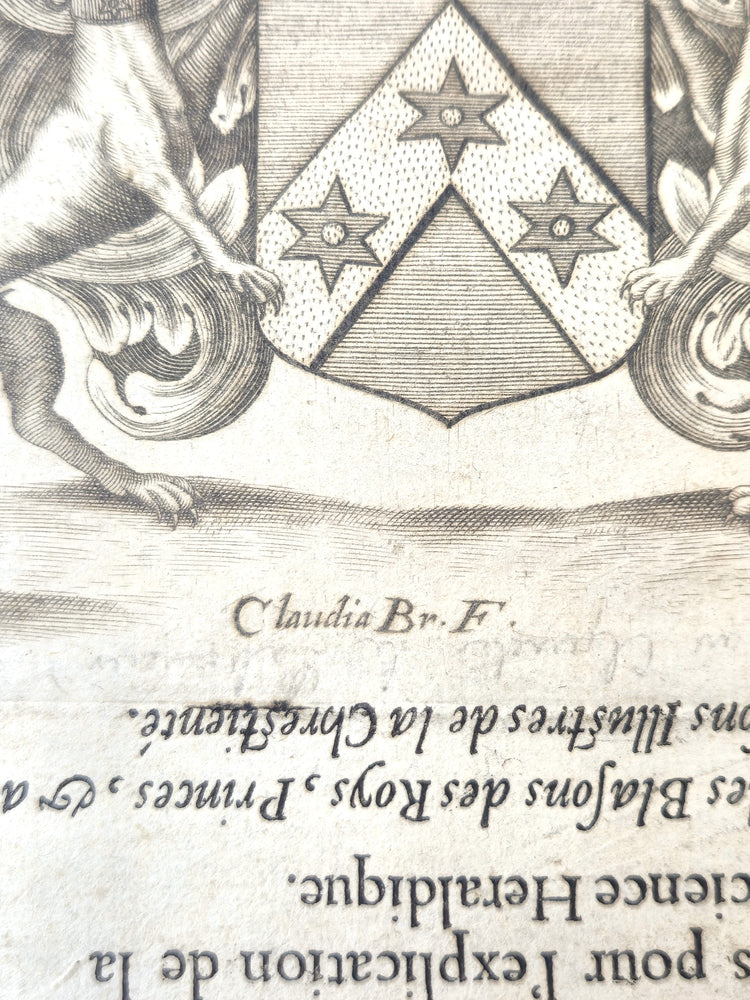
First edition of the book that caused a dispute because it was illustrated by a woman. The Lyon engraver Claudine Brunand made the heraldic plates for this treatise on the origins and language of heraldry by Le Laboureur, in which the arms of royal and noble families accompany explanations of heraldic charges and the division of the shield. The engravings allow readers to compare the terminology with examples, from elaborate quarterings to punning devices based on family names.
The book prompted a prolonged dispute between Le Laboureur and the Jesuit heraldist Claude-François Ménestrier. Ménestrier objected to Brunand engraving the Coglioni family’s canting arms on p. 32, whose three testicles pun on the family name. Paul Allut describes Ménestrier’s reproach as “pour y avoir employé le burin d’une fille” (“for having employed a young woman’s burin”; 1856, p. 25).
Brunand signed the title vignette “Claudia Br. F.”. Heraldry formed a substantial part of her work, and in 1669 she published her own Armorial véritable. Véronique Meyer’s research (2020), drawing on collections in Lyon, the Mazarine and the Arsenal, has documented these heraldic commissions alongside portraits and devotional prints, revealing a more extensive and varied oeuvre than earlier inventories suggested.
Brunand’s later writings provide a revealing counterpart to Ménestrier’s criticism. In her prefaces and dedications, she challenged the belief that heroic deeds were the preserve of men, invoking strong women and Amazons to defend women’s abilities. Edited by Meyer in Propos d’une graveuse (2019), these texts preserve her own arguments for female achievement and her reflections on her position as a woman engraver.
Condition:
Without the (often lacking) separately printed table of families. Binding repaired at the hinges, covers slightly worn. Two bookplates on front pastedown and first free endpaper. Minor spots and slight browning to the title-page, small tear to the lower corner of the leaf bearing pp. 159–160, outside the text. otherwise in very good condition.
Bookplates of:
- Henry Le Court (1849–1921), French notary, genealogist and bibliophile specialising in Norman history and heraldry.
- Sunil Saigal (1960–2023), Danish UN diplomat, heraldic scholar and artist.
References:
Allut, Paul. Recherches sur la vie et sur les œuvres du P. Claude-François Menestrier de la Compagnie de Jésus. N. Scheuring, 1856, p. 25.
Meyer, Véronique. Propos d’une graveuse: Claudine Brunand, 1630–1674. Comité national de l’estampe, 2019.
Meyer, Véronique. “Claudine Brunand, femme et graveuse.” Nouvelles de l’estampe, no. 263, 2020.
Meyer, Véronique. “Six femmes graveurs en France au XVIIe siècle. Les sœurs Bouzonnet-Stella, Marie Briot, Claudine Brunand et Madeleine Masson.” Femmes artistes à l’âge classique. Arts du dessin – peinture, sculpture, gravure, Classiques Garnier, 2021, pp. 45–59.
Couldn't load pickup availability
Share


Contact
Email: hugo@artemrarebooks.com
Phone: +31651042297
Visit us on appointment at:
Former US Embassy
Lange Voorhout 102
2514EJ
The Hague (The Netherlands)
Shipping address:
Nannie van Wehlstraat 51
2548MN
The Hague
The Netherlands