


Exceptional large manuscript on silk weaving, with technical drafts, mounted fabric samples, and silk-trade accounts.
- Regular price
- €0,00 EUR
- Regular price
-
- Sale price
- €0,00 EUR
- Unit price
- per
Claudius Bost (student); Jules Mercier (professor).
Théorie de la fabrication des étoffes de soie.
Lyon, ca. 1840-1854.
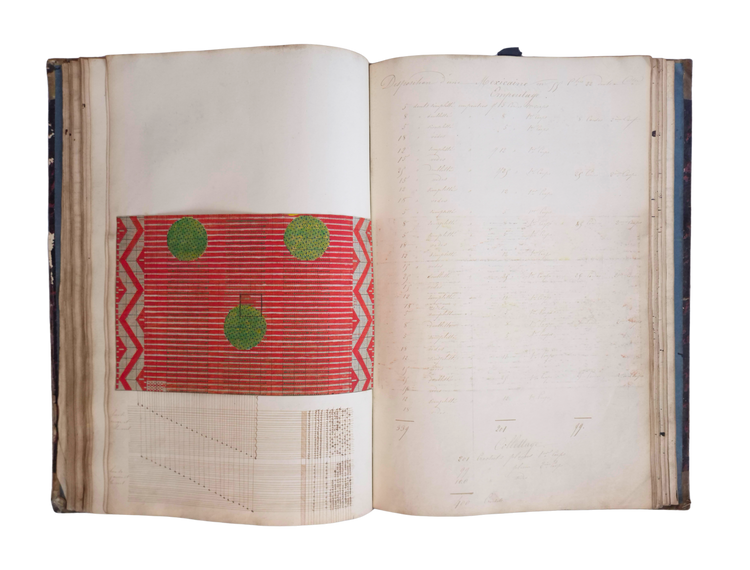
Large folio (29 × 45 cm). Lithographed title page with name in ink, followed by 76 manuscript leaves of course notes and technical diagrams, then 33 manuscript leaves of accounts relating to a silk-manufacturing enterprise dated between 1848 and 1854, followed by some 30 blank leaves. Numerous ink diagrams of weaving drafts and loom arrangements; approximately 30 mounted silk fabric samples.
Contemporary half-vellum over marbled boards, vellum corners; vellum spine panelled in blind with exposed sewing supports intended for manuscript labels.
A rare surviving student notebook-turned account book, documenting the technical training of the Lyon silk industry in the mid-nineteenth century, combining theoretical instruction, detailed weaving drafts, and mounted silk samples illustrating the finished fabrics.
The manuscript is organized in three distinct sections. The opening portion contains the theoretical component of the course, presenting a written exposition on silk and silk manufacture together with introductory technical explanations and schematic diagrams.
The central and largest section forms the practical part of the course: a series of technical case studies describing the construction of different types of silk fabrics. Each example is introduced under headings such as Disposition d’un Pékin, Disposition d’un Damas, Disposition d’un Gros de Tours, or Disposition d’une Bordure de meubles, and systematically records the successive stages of loom preparation and weaving—empoutage, colletage, remettage, ourdissage, lissage, and tissage. These entries are accompanied by carefully ruled weaving drafts showing the interlacing of warp and weft threads, as well as by mounted silk samples demonstrating the corresponding woven result.
The fabrics represented include striped silks, figured silks, damasks, and decorative furnishing textiles, reflecting the range of luxury fabrics produced by the Lyon silk industry during the nineteenth century. In several cases larger mounted textile fragments illustrate the relationship between the technical weaving diagram and the finished patterned fabric. The precision of the diagrams and the systematic terminology used throughout indicate that the notebook was produced as part of formal technical instruction in mise-en-carte, the specialized discipline responsible for translating textile designs into weaving instructions for Jacquard looms.
At the end of the technical material the notebook was reused to record the accounts of a silk-manufacturing enterprise, arranged in ledger format with headings such as Doit and Avoir and listing transactions with several individuals between 1848 and 1854. The notebook thus appears to have served both as the course notes of a student attending the specialized class of Jules Mercier at the Lyon École des Beaux-Arts and later as a practical working reference within the silk trade itself. The blank leaves at the end suggest the volume was intended for further use but ultimately left unfinished.
Lyon had historically been the European capital of silk fabric production, and during the latter half of the nineteenth century, the industry experienced unprecedented growth and innovation. Lyon solidified its status as the silk capital of the world, driving urbanization, population growth, and economic prosperity in the region. Women were integral to Lyon's silk industry, working in various roles from weaving to design. They contributed significantly to production, both in factories and at home, supporting the city's economic growth and its reputation as a silk center.
Condition: minor wear to extremities, binding sound. Title page loosening. Interior generally clean with occasional stains and traces of workshop use.
Couldn't load pickup availability
Share


Contact
Email: hugo@artemrarebooks.com
Phone: +31651042297
Visit us on appointment at:
Former US Embassy
Lange Voorhout 102
2514EJ
The Hague (The Netherlands)
Shipping address:
Nannie van Wehlstraat 51
2548MN
The Hague
The Netherlands