


Inventory of the Governor’s plantation estate
- Regular price
- €9.500,00 EUR
- Regular price
-
- Sale price
- €9.500,00 EUR
- Unit price
- per
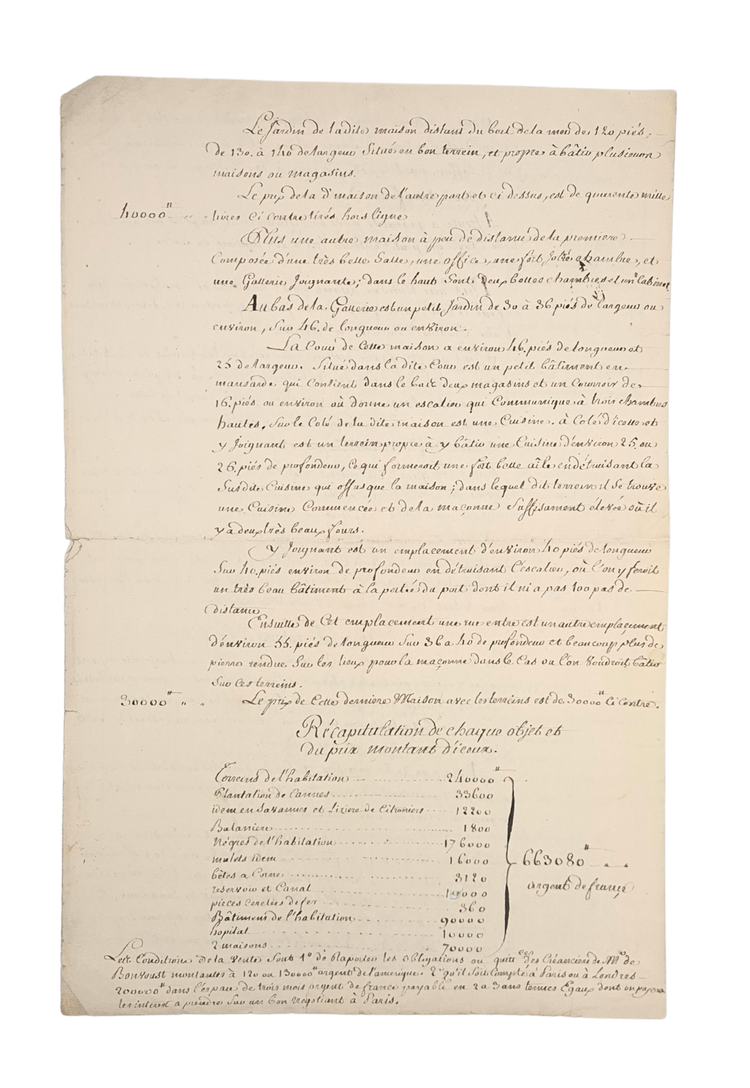
Important set of two manuscripts recording the plantation, urban properties, enslaved labor force, buildings, livestock, and industrial installations of Pierre Claude, Baron de Bonvoust, Governor of Grenada.
Grenada, circa 1763.
Folio [4; 2] pp. French manuscript in ink on laid paper.
Pierre Claude, Baron de Bonvoust (1691-1785), served as Governor of Grenada from 1757 to 1762, until the cession of the island by France to Great Britain. Compiled shortly after this period, these administrative and economic documents offer a rare and remarkably complete record of the baron’s exceptional wealth on the island, encompassing not only land, buildings, and industrial installations, but also the enslaved people whose labour underpinned the plantation economy.
The first manuscript opens with an “État général des domaines appartenans à Monsieur le Baron de Bonvoust, circonstances et dépendances”, enumerating:
- His principal plantation (“habitation”) situated in the district of Basse-Terre, Island of Grenada, at a short distance from the principal port and town;
- The enslaved people and livestock employed on the plantation;
- Two houses and several parcels of land located within the town.
A long and precise description follows of the habitation, comprising approximately 120 carrés of land of very good quality, including extensive cane fields, savannas, and provision grounds. Portions of the land are planted in sugar cane already in production, with further areas suitable for expansion. The valuation of the land alone is carefully calculated, parcel by parcel.
The manuscripts provide an exceptionally detailed account of the plantation infrastructure, including:
- A complete sugar works (sucrerie) with water-powered mill, boiling house, curing house, furnaces, cauldrons, purging room, canals, reservoirs, and ancillary buildings;
- Storehouses, magazines, workshops, kitchens, hospital, and housing for enslaved workers;
- Construction materials, dimensions of buildings (often given in feet), and their state of repair;
- An extensive canal system supplying water to the mill, with masonry basins and dikes.
The urban properties are described at length: two substantial houses in town, with galleries, halls, chambers, offices, kitchens, courtyards, gardens, outbuildings, cellars, and additional land suitable for warehouses. Their proximity to the port and commercial utility are emphasized, and each element is individually valued.
A separate manuscript titled “Nègres servant à l’exploitation de l’habitation” provides a functional description of the enslaved labor force. It records a total of approximately 110–120 enslaved people, described as “seasoned,” including:
- Skilled sugar workers (notably refiners capable of operating a sugar works);
- A mason, a master cooper, carpenters;
- Cooks, carters, laundresses, and domestic servants.
The collective valuation of the enslaved workforce is set at 176,000 livres, forming a major component of the estate’s overall value.
One manuscript contains a complete nominal list of the enslaved people of the Baulieu plantation, titled “Liste des Nègres de l’habitation de Baulieu située en l’isle de la Grenade.”
This list records men, women, and children individually by name, with:
- Age (ranging from 58 years to infants of one year);
- Assigned monetary value (ranging from 2,500 livres to 150 livres).
The manuscripts also include a final recapitulation summarizing the value of each component of the estate: land, plantations, savannas, buildings, sugar works, enslaved people, livestock, canals, iron fittings, hospital, and town houses. The total valuation amounts to 663,080 livres, underscoring the exceptional scale and wealth of the Baron de Bonvoust’s Grenadian holdings.
Together, these documents expose the full economic and human architecture of a governor’s plantation estate at a pivotal moment in Grenada’s colonial history.
Condition: some minor folds and fraying, otherwise in very good condition.
*this comes with an export licence.
Couldn't load pickup availability
Share


Contact
Email: hugo@artemrarebooks.com
Phone: +31651042297
Visit us on appointment at:
Former US Embassy
Lange Voorhout 102
2514EJ
The Hague (The Netherlands)
Shipping address:
Nannie van Wehlstraat 51
2548MN
The Hague
The Netherlands