


Japanese interwar textile album of 62 European and American fabrics
- Regular price
- €3.900,00 EUR
- Regular price
-
- Sale price
- €3.900,00 EUR
- Unit price
- per
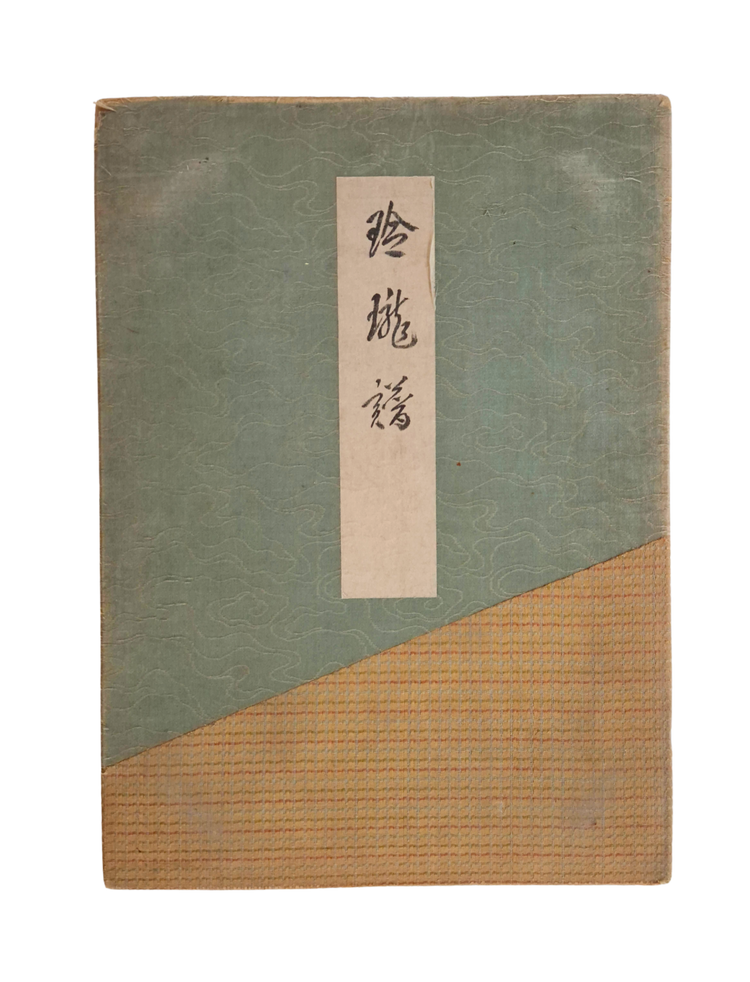
珍織譜 (Chinshokufu – “Album of Rare Weavings”).
Kyoto (Nishijin), 西陣染織研究會 (Nishijin Dyeing and Weaving Research Association), Shōwa 8 (1933).
Folio leporello (37 × 27 cm) in original patterned cloth boards with paper title label. 31 boards containing 62 numbered textile specimens (No. 1–62) mounted on printed cards with descriptive Japanese text and red seal stamps. Prefatory text printed in vertical Japanese type and dated April 1933. Complete.
Produced in Kyoto’s historic Nishijin weaving district during the early Shōwa period, this album was compiled by the Nishijin Dyeing and Weaving Research Association as part of its effort to study and disseminate knowledge of modern Western textile design and manufacturing techniques. It is an important documentary record of how the Japanese textile industry examined European and American fabrics during the interwar period. According to the preface, many of the specimens were collected during research trips to Europe by Asai Shūkichi, then head of a municipal dyeing and weaving testing institute, who gathered representative fabrics while visiting European textile producers. These materials were later deposited with the association and published as a reference for designers, manufacturers, and students of textile production.
Each panel contains a textile specimen mounted on a printed card with its sample number and short explanatory text. The printed headings identify the fabric type (品種), place of origin (産地), and intended use (用途). The samples therefore function not only as design references but also as technical documentation of contemporary Western textiles. The listed places of origin include France (仏国), Germany (独逸), the United States (米国), and England (英国), reflecting the principal foreign textile industries studied by Japanese manufacturers during the period.
The fabrics show a wide variety of modern industrial textiles—printed cottons, decorative silks, rayon and silk-rayon blends, patterned weaves, chiffon, velvet, gauze, and other experimental textures. The intended uses recorded on the cards include women’s dress fabrics (婦人服地), eveningwear textiles (夜会服地), hat materials (帽子地), curtain fabrics (窓掛地), and interior decorative textiles (室内装飾地). Several patterns display the bold colors, geometric ornament, and stylized motifs characteristic of European Art Deco textiles of the late 1920s and early 1930s.
The printed cards bear a publisher’s statement and seal indicating that the album was issued by the “Jūgo-kai” (十五會) within the International Trade Research Association (國際貿易研究會), suggesting that the project was connected to broader efforts to study foreign textile production and promote industrial knowledge within Japan.
Albums such as this were intended as practical study tools rather than sales catalogues, and many surviving examples are incomplete because the samples could be removed for reference. The present album retains the complete sequence of sixty-two specimens, preserving a rare and detailed record of how Western textile design, materials, and industrial techniques were studied and analyzed by the Japanese textile industry during the interwar years.
Condition: Some leaves detached. Minor wear and light toning. Textile samples sometimes creased, otherwise in very good condition.
Couldn't load pickup availability
Share


Contact
Email: hugo@artemrarebooks.com
Phone: +31651042297
Visit us on appointment at:
Former US Embassy
Lange Voorhout 102
2514EJ
The Hague (The Netherlands)
Shipping address:
Nannie van Wehlstraat 51
2548MN
The Hague
The Netherlands