


“Par de jeunes artistes des deux sexes”
- Regular price
- €1.900,00 EUR
- Regular price
-
- Sale price
- €1.900,00 EUR
- Unit price
- per
François Basan (Paris, 1723–1797), compiler and publisher, after the collection of Antoine Poullain (d. 1780).
Collection de cent-vingt estampes, gravées d’après les tableaux & dessins qui composoient le cabinet de M. Poullain, receveur général des domaines du Roi, décédé en 1780. Précédée d’un abrégé historique de la vie des auteurs qui la composent. Dédiée à M. le Comte d’Orsay.
Paris, chez Basan et Poignant, 1781.
Large 4° (31 x 25,5 cm). [4], 22, [2] pp. With 120 engraved plates on 116 leaves, including two engraved title plates. Plates on stiff wove paper, text on laid blue paper. Text leaves bound after the plates.
Contemporary red mottled calf with gilt spine, gilt top edge.
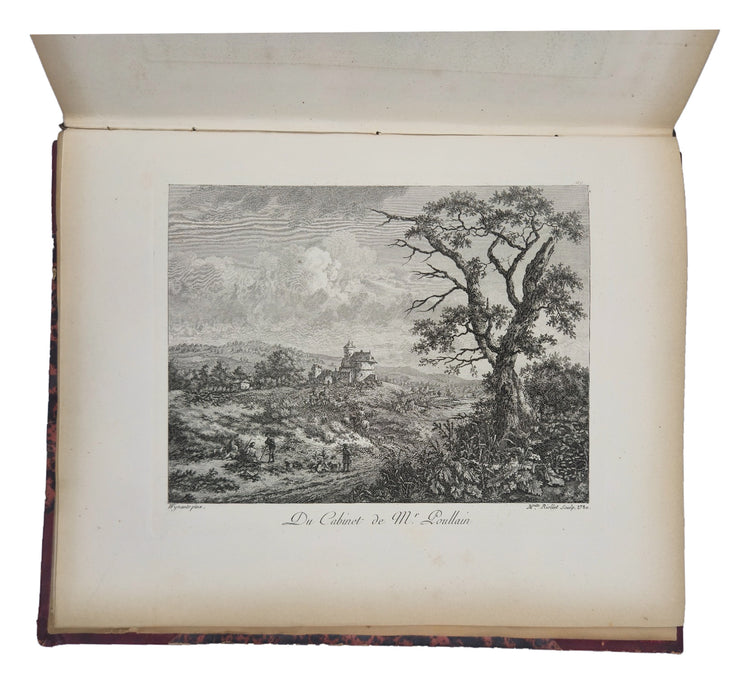
First and only edition of this important illustrated record of the celebrated collection of Antoine Poullain, receveur général des domaines du Roi. Following Poullain’s death in 1780, his cabinet was dispersed, and many of the paintings represented here subsequently entered major European collections. The volume reproduces paintings and drawings by artists including Rembrandt, Rubens, Van Dyck, Claude Lorrain, Gerrit Dou, Jordaens, Jan Wijnants, Gerard ter Borch and Lingelbach.
The work is especially significant for the history of women in eighteenth-century printmaking. Basan’s title explicitly states that the suite was executed under his direction by de jeunes artistes des deux sexes—“young artists of both sexes”. The present copy contains the work of five named women printmakers, responsible for eight of the 120 numbered plates. Their participation was not incidental: recent scholarship has shown that the Cabinet Poullain brought together entire professional and familial networks of engravers, including the sisters Marguerite and Thérèse-Éléonore Hémery, their husbands Nicolas Ponce and Charles-Louis Lingée, and their brother Antoine-François Hémery.
Rose-Angélique Moitte (c. 1745–1820) engraved plate no. 5. She was the daughter and pupil of the painter and engraver Pierre-Étienne Moitte.
Thérèse-Éléonore Hémery, married Lingée (Paris, 1753–after 1814) contributed three plates: nos. 7, 16 and 59. These include scenes of music and sociability and the allegorical figure of Pictura. Lingée specialised in the crayon manner and stipple engraving and was later admitted to the Académie de peinture et de sculpture in Marseille. Her plate no. 59, after Frans van Mieris, has been singled out in recent scholarship as one of the most accomplished contributions to the Cabinet Poullain. Basan himself later praised her work in the collection.
Thérèse Chenu, later Madame Desmaisons (d. 1824) engraved plate no. 83, a bust of a man in a turban. She was a burin engraver and the sister of the engraver Pierre Chenu.
Marguerite Hémery, married Ponce (Paris, 1745–1832) engraved plate no. 103 after Gerard ter Borch’s Horse Stable, now in the J. Paul Getty Museum. The elder sister of Thérèse-Éléonore Hémery, she worked independently as an engraver while also collaborating in projects with her husband Nicolas Ponce. Her prints were generally signed “Madame Ponce”, a professional designation that simultaneously asserted her own authorship and her connection to her husband’s established workshop. Her presence here is particularly revealing: two sisters worked side by side within the same major reproductive enterprise, alongside their husbands and brother.
Marie-Catherine Riollet (Paris, 1755–1788) engraved nos. 118 and 119, after Jan Wijnants and Lingelbach. Riollet worked in both etching and engraving, signing her prints “Mlle Riollet”, and contributed to several illustrated catalogues of private collections before her early death. She later married the engraver Jacques-Firmin Beauvarlet.
These five artists are not presented as an exceptional or separate group: their plates are integrated into the same commercial reproductive programme as those of their male colleagues. The volume therefore offers unusually clear evidence of women’s participation in the Parisian print trade, where family workshops, specialist training and large collaborative publishing projects provided important professional opportunities. Particularly striking is the presence of the Hémery sisters within the same enterprise, working alongside their male relatives yet signing their own plates. The Cabinet Poullain thus preserves not merely isolated instances of female participation, but evidence of women operating within the professional networks at the heart of eighteenth-century Parisian print production.
Condition: text leaves untrimmed. Plate leaves bound before the text. The binding is rubbed along the spine, corners, and board edges, while the marbled paper sides show surface wear and scuffing. Internally, the preliminary leaves, including the title page, are more noticeably browned and show scattered foxing and occasional larger brown stains. The plates are generally cleaner, with light age toning and occasional marginal foxing; the engraved images remain clear and well preserved. One plate leaf has a short split at the inner gutter, not affecting image. Overall, a solid and attractive copy in good condition.
References: Brunet, I, 686; Cohen-De Ricci, 116.
Martin, Kelsey D. “Divine Secrets of a Printmaking Sisterhood: The Professional and Familial Networks of the Horthemels and Hémery Sisters.” Female Printmakers, Printsellers, and Print Publishers in the Eighteenth Century: The Imprint of Women, c. 1700–1830, edited by Cristina S. Martinez and Cynthia E. Roman, Cambridge University Press, 2024, pp. 91–107. doi:10.1017/9781108953535.009.
British Museum. “Cabinet Poullain: Collection de cent-vingt estampes gravées d’après…” The British Museum, collection no. 1853,1008.421. Accessed 17 Sept. 2026.
Couldn't load pickup availability
Share


Contact
Email: hugo@artemrarebooks.com
Phone: +31651042297
Visit us on appointment at:
Former US Embassy
Lange Voorhout 102
2514EJ
The Hague (The Netherlands)
Shipping address:
Nannie van Wehlstraat 51
2548MN
The Hague
The Netherlands