


Presentation copy of the first history of Haiti by a Haitian, published in Haiti by a man of colour
- Regular price
- €12.500,00 EUR
- Regular price
-
- Sale price
- €12.500,00 EUR
- Unit price
- per
Thomas Madiou (Port-au-Prince 1815-1884).
Histoire d’Haiti.
Port-au-Prince, Imprimerie de Joseph Courtois, 1847-1848.
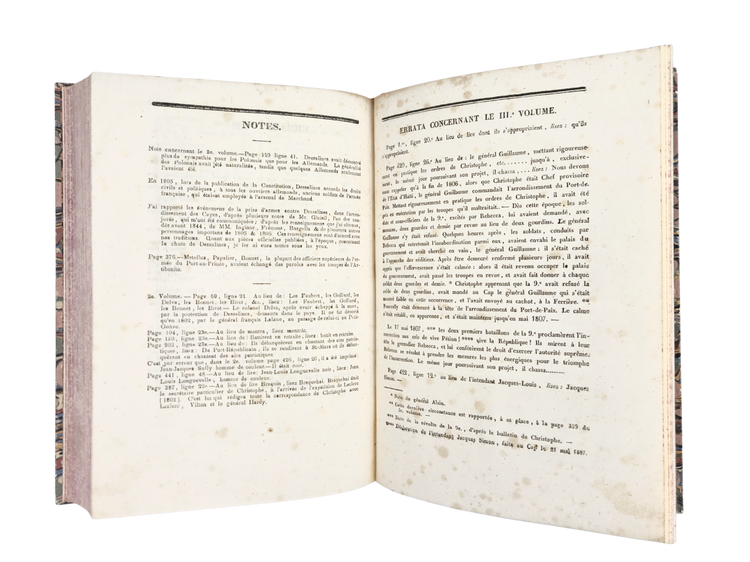
3 volumes. 8°. [2], VIII, 370; 447, [1 blank]; 508, [2] pp. (complete incl. errata).
Woodcut of the Haitian national emblem on each title-page, surrounded by the words “Indépendance nationale. Liberté. Progrès.”
Later half calf with marbled sides.
Inscribed on first title-page by the author.
Presentation copy of a very rare and important completely Haitian book. This first edition contains the first comprehensive history of Haiti written by a Haitian author from a distinctly Haitian perspective. Written in Haiti and printed in Port-au-Prince by Joseph Courtois, it is also an important monument to the intellectual and printing culture of the young republic. Chadenat described it as “la meilleure histoire de la période de l’indépendance d’Haïti.”
Covering the history of the island from 1492 to 1807, the work concentrates particularly on the Haitian Revolution and the establishment of independence. It contains the 1685 Code Noir; Sonthonax’s 1793 proclamation of general emancipation; Toussaint Louverture’s 1801 Constitution de Saint-Domingue; and the Constitution of Haiti of 1805.
Madiou’s account differed fundamentally from the histories produced by European writers. In addition to consulting published French sources, he drew upon the recollections of Haitian statesmen, revolutionary veterans, and other surviving witnesses. He interpreted the Revolution as a legitimate struggle against the violence and oppression of slavery, rather than as a disastrous interruption of French colonial rule. The result has been recognised as a masterpiece not only of Haitian and Caribbean historiography, but of nineteenth-century historical writing in French.
Born in Port-au-Prince, Madiou was educated at the Collège Royal d’Angers before studying law in Paris. There he met Isaac Louverture, son of Toussaint Louverture, an encounter said to have encouraged his interest in the history of his country. After returning to Haiti, Madiou occupied several positions close to the centre of political life. He served as secretary to Joseph Balthazar Inginac, an influential minister under President Jean-Pierre Boyer, and directed the government’s official newspaper, Le Moniteur. His access to Haiti’s political establishment and to the living memory of the revolutionary generation gave his history an authority unavailable to most foreign writers.
The circumstances of the book’s publication are equally significant. Its printer, Joseph Courtois (1785–1877), belonged to a prosperous free family of colour in colonial Saint-Domingue and was educated in Paris. His brother, Sévère Courtois, participated in the Haitian Revolution. After independence, Joseph and his wife, Juliette Bussière Laforest-Courtois, devoted themselves to education and publishing, establishing an early school for girls and managing the newspaper La Feuille du Commerce. Courtois was repeatedly imprisoned for alleged defamation, during which periods Juliette continued the newspaper herself. Shortly after printing Madiou’s history, he was forced to leave Haiti during the political persecution accompanying the rise of Faustin Soulouque; he returned in 1859.
The index at the end of each volume identifies individuals according to the racial terminology of the period—blanc, noir, or homme/femme de couleur—making visible the racial classifications through which nineteenth-century Haitian history was recorded.
The third volume appeared in 1848, the year in which France definitively abolished slavery throughout its colonies. A posthumous continuation, covering the years 1843–1846 and reportedly based on Madiou’s surviving manuscripts, was published by his descendants in 1904.
The author’s presentation inscription gives this copy particular significance, providing a direct material connection to the historian responsible for Haiti’s first great national history.
Condition: Foxed throughout, more extensively in places (as the only other two copies we have seen). Repairs to the first three leaves of volume III. Otherwise in good condition.
References: Chadenat 362; Le Clerc, Bibliotheca Americana, 4838, p. 641; Sabin 43704; Scheler, Voyages–Marine, 552.
Literature:
Adélaïde-Merlande, Jacques. La Caraïbe et la Guyane au temps de la Révolution et de l’Empire, 1789–1804. Karthala, 1992.
Mongey, Vanessa. “A Tale of Two Brothers: Haiti’s Other Revolutions.” The Americas, vol. 69, no. 1, 2012, pp. 37–60. https://doi.org/10.1353/tam.2012.0062.
Nicholls, David. “A Work of Combat: Mulatto Historians and the Haitian Past, 1847–1867.” Journal of Interamerican Studies and World Affairs, vol. 16, no. 1, 1974, pp. 15–38. https://doi.org/10.2307/174998.
Couldn't load pickup availability
Share


Contact
Email: hugo@artemrarebooks.com
Phone: +31651042297
Visit us on appointment at:
Former US Embassy
Lange Voorhout 102
2514EJ
The Hague (The Netherlands)
Shipping address:
Nannie van Wehlstraat 51
2548MN
The Hague
The Netherlands