


Printed naval science from Bulaq: knowledge in transit in the Arab region
- Regular price
- €12.500,00 EUR
- Regular price
-
- Sale price
- €12.500,00 EUR
- Unit price
- per
[“Kapudân Antûn (Captain Antoine)”; translated by Meḥmet Efendi Mustafâ el-Tercüman(?)].
مجموعة فن البحرية [Mecmûa-i Fenn-i Bahriye; Compendium of Naval Science].
Bulaq [Cairo], Dâr al-Tibâʿa al-ʿÂmira / Bulaq Press, Muharram 1254 AH [March–April 1838].
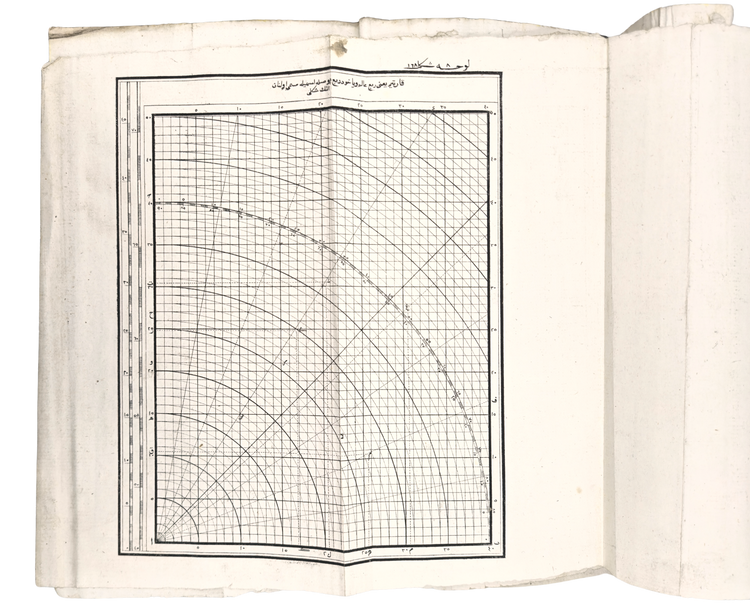
Folio, 30,5 x 20 cm. XIV, IV, 92, 48, 98, 176, 158 pp. With 10 folding lithographed plates, including maps, astronomical and geometrical diagrams, navigational instruments and tables. Ottoman Turkish in Arabic script.
With Ottoman-Turkish ownership inscriptions to the front pastedown, including the formula “bu kitābın ṣāḥibi” (“the owner of this book”) and names including, apparently, Seyyid Davud, Mehmed, Ömer and Necib.
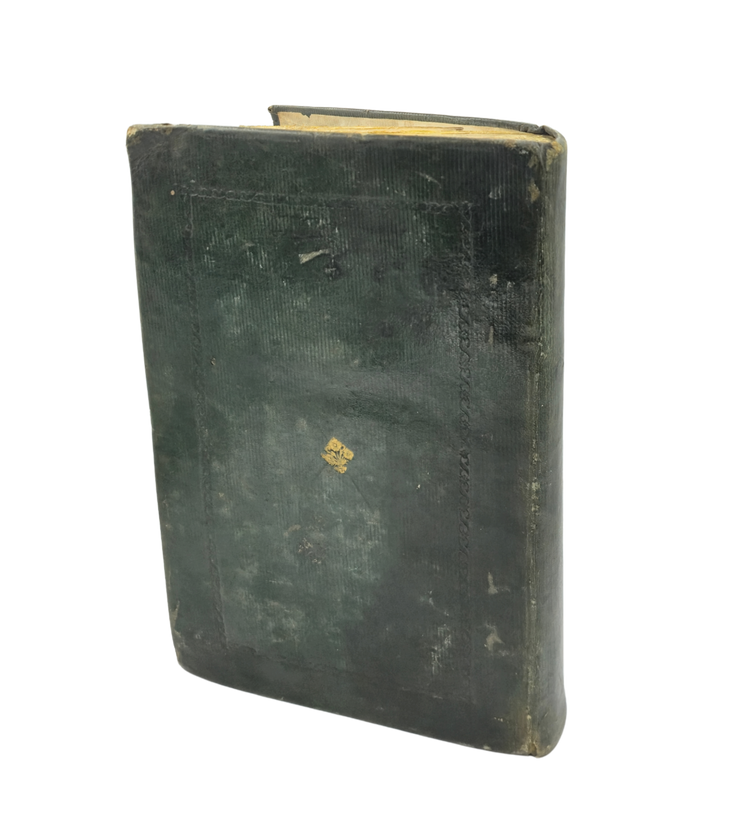
Contemporary full green calf, with a small gilt floral ornament, spine plain, yellow edges. Binding rubbed and partly worn; endpapers lacking; first leaf partly loose; ownership note to inside upper board.
A remarkable early example of scientific knowledge in transit through print in the Arab region: this Bulaq-printed manual with folding lithographed plates transforms European naval science into Ottoman-Turkish instruction for use in the Arabic maritime world. Produced in Cairo in Ottoman Turkish, Mecmûa-i Fenn-i Bahriye is not only a book about navigation, but also a material witness to the movement of technical knowledge across languages, institutions and regions in the early nineteenth-century Arabic-speaking world.
The Bulaq press was the first Arab indigenous modern printing press and thus one of the foundational institutions of modern print culture in the Arab region. Although Arabic-script printing had earlier precedents, and Napoleon’s expedition had briefly introduced printing to Egypt, Bulaq was the first sustained state press in Egypt, established under Muḥammad ʿAlī Pasha. This work belongs to its early technical and military publishing programme and in its scope and presentation it is a particularly ambitious example.
This “first printing” (see colophon) offers a substantial compendium of naval and maritime science, prepared as a practical and instructional manual for navigation, seamanship and naval education. The work is arranged in five parts and covers the mathematical, astronomical and practical foundations of navigation, including geometry, calculation, the movements of celestial bodies, tides, hydrography, coastal phenomena and sailing directions.
The book opens with an ornamental lithographic title-page headed Fenn-i Bahriye, “Maritime Science”, followed by the first part, Mabādiʾ-i Fenn-i Baḥriyye, “Principles of Maritime Science”. The opening defines navigation as the movement of a vessel from one point of the sea to another by means of calculated direction, distance and position. The work therefore begins with the mathematical disciplines necessary for navigation before proceeding to practical seamanship. Later sections treat the movements of the tides, the calculation of courses and distances, the determination of latitude and longitude, and the application of numerical tables to real navigational problems.
The ten folding lithographed plates form the scientific apparatus of the book. They include a coastal chart with rhumb lines, circular astronomical diagrams, geometrical constructions, an armillary sphere, protractors and navigational instruments, including a sextant-like instrument. These plates are not merely decorative illustrations: the final pages of the text explicitly refer the reader to the following tables and diagrams for the calculation of latitude, longitude, distance, course and the point of arrival. The final printed statement, placed on the verso of the last folding plate, records the printing at Cairo in Muharram 1254 AH and states that this was the first printing. It also names this book as Kitāb al-Baḥr (The Book of the Sea).
As such, Mecmûa-i Fenn-i Bahriye is more than a manual of seamanship. It is a printed course in the sciences of navigation and one of the clearest examples of how early nineteenth-century Egyptian printing could turn specialised European knowledge into locally usable technical instruction. It stands at the intersection of European naval science, Ottoman-Turkish translation, Egyptian state reform and the emergence of modern technical print culture in the Arab world.
Condition: Binding a bit rubbed. Contents generally in excellent clean and bright condition; some spotting to the blank edges of some folding plates, minor foxing to some index leaves. Two contemporary inscriptions on front paste-down.
References:
Heyworth-Dunne, J. “Printing and Translations under Muḥammad ‘Alī of Egypt: The Foundation of Modern Arabic.” Journal of the Royal Asiatic Society, vol. 72, no. 4, 1940, pp. 325–349.
İhsanoğlu, Ekmeleddin. “The Bulaq Press and the Turkish Books Printed There.” The Turks in Egypt and Their Cultural Legacy, edited by Humphrey Davies, American University in Cairo Press, 2012, pp. 323–344.
Verdery, Richard N. “The Publications of the Būlāq Press under Muḥammad ʿAlī of Egypt.” Journal of the American Oriental Society, vol. 91, no. 1, 1971, pp. 129–132.
Couldn't load pickup availability
Share


Contact
Email: hugo@artemrarebooks.com
Phone: +31651042297
Visit us on appointment at:
Former US Embassy
Lange Voorhout 102
2514EJ
The Hague (The Netherlands)
Shipping address:
Nannie van Wehlstraat 51
2548MN
The Hague
The Netherlands