


Rare 18th-century weaving pattern book with 72 full-page designs
- Regular price
- €5.500,00 EUR
- Regular price
-
- Sale price
- €5.500,00 EUR
- Unit price
- per
Johann Michael Frickinger (active 1740-1767).
Nützliches in lauter auserlesenen, wohl-approbirt- und meistentheils neu-inventirten Mustern bestehendes, Weber-Bild-Buch, als Zwei und Siebenzich gesteinten Zeichnungen von 15. bis auf 40. schäfftig, und 32. Stück 16. und 20. schäfftigen Hin- und Wieder-Mödel, auch allerhand der nettesten Gattungen von rothgestreifften Arbeiten, sammt denen dazu gehörigen Zügen und Schnürungen [...] Wobei auch einer jeden Gattung insonderheit eine schrifftliche Anleitung voran gedrucket worden.
Schwabach & Leipzig, Chr. H. Steinmarck for J. J. Enderes, 1740.
Oblong folio (23,5 x 33,5 cm). [5], 93 (= 94, 39 is numbered twice), 94–95, 96–100 leaves (text f. 95 printed on verso of 94 as usual). Title in red and black. With 72 numbered and 7 unnumbered full-page woodcuts (some folding) and several woodcuts in the text. Complete.
Modern half vellum with marbled sides.
First edition of this rare and interesting Weber-Bild-Buch, “one of the very few recorded 18th-century weaving pattern books” (see Bibliographica Textilia Historiae).
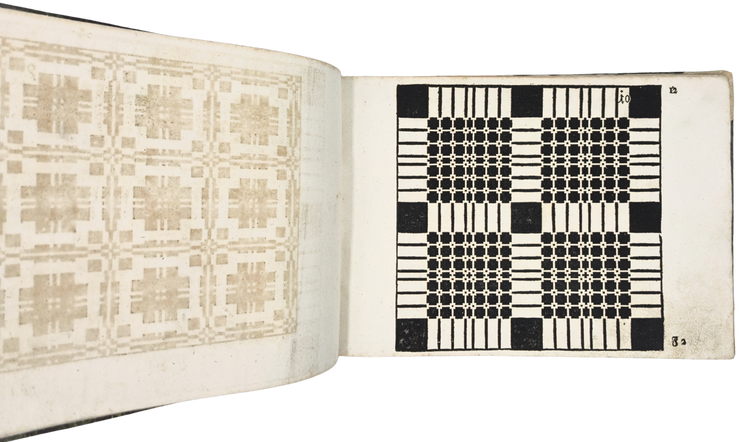
This renowned pattern book is illustrated with 72 full-page weaving patterns which today seem nearly modern abstract art. Indead, as noted by the Winterthur Library, “the striking graphic quality of its weaving patterns seems quite contemporary today.”. Strangely, these illustrations are often described in catalogues as lithographs (including in the VD18 database), but this is clearly impossible, as lithography was only invented many decades later; the plates are therefore most likely woodcuts.
The work was compiled by Johann Michael Frickinger, court weaver and designer in Ansbach (then often written Onolzbach), and was intended as a practical manual for professional weavers. Frickinger explicitly notes the lack of printed instructions for the production of newer patterned fabrics and different textile weights; the present work was conceived to remedy this deficiency by providing clear directions that would allow craftsmen to adapt and modify patterns according to their needs. The volume contains a wide range of patterned designs together with diagrams indicating threading and weaving structures. Frickinger presents increasingly complex striped and figured patterns reflecting the growing sophistication of eighteenth-century looms, which permitted more elaborate combinations of colour in the weft. First published in 1740, the work proved influential and was reissued in later editions (notably 1767 and 1783). It remains an important document for the history of textile design and technology, offering a valuable source for eighteenth-century weaving techniques and pattern development.
A facsimile edition with scholarly study was published in 1996 by Patricia Hilts at the Charles Babbage Research Centre, Northwestern University.
Condition: The volume shows clear signs of having been used for its intended purpose, with traces of handling throughout, including frequent thumbing, occasional pencil doodles of clothing designs, and two loose sheets with manuscript weaving patterns, probably dating from around 1900. The leaves are slightly trimmed, just touching the text on the title page and the final page, and occasionally the edges of some illustrations. One illustration lacks a corner. There are also a few old marginal repairs. Altogether a used but complete and sound copy.
References:
VD18 11491620; Rosenthal 401; Lipperheide, Kostümbibliothek, Yb 3 (with insufficient indication of the number of plates); Katalog der Ornamentstichsammlung des Kunstgewerbemuseums Berlin, no. 1664; Siegelaub, Bibliographica Textilia Historiae (1997), p. 129, CS-ROT 4251.
Further literature:
Patricia Hilts, The Weaver’s Art Revealed: Weber Kunst und Bild Buch, Charles Babbage Research Centre, 1990.
Katharine Martinez (ed.), American Cornucopia: Treasures of the Winterthur Library, Winterthur, Delaware, 1990, fig. 25.
Patricia Hilts and Johann Michael Frickinger, An Eighteenth-Century Court Weaver’s Pattern Book: Facsimile, Translation, and Study of the Nützliches Weber-Bild-Buch (1740) of Johann Michael Frickinger, Court Weaver at Ansbach, Charles Babbage Research Centre, 1996.
Couldn't load pickup availability
Share


Contact
Email: hugo@artemrarebooks.com
Phone: +31651042297
Visit us on appointment at:
Former US Embassy
Lange Voorhout 102
2514EJ
The Hague (The Netherlands)
Shipping address:
Nannie van Wehlstraat 51
2548MN
The Hague
The Netherlands