


Removing women’s bladder stones without the knife
- Regular price
- €1.500,00 EUR
- Regular price
-
- Sale price
- €1.500,00 EUR
- Unit price
- per
Domenico Masotti (1698–1779).
Lettera di Domenico Masotti lettore d’istituzioni chirurgiche e professore di litotomia nel Regio Spedale di S. Maria Nuova di Firenze sopra gl’instromenti necessari per la litotomia nelle donne e sopra l’ago barbeziano.
Florence: Andrea Bonducci, 1756.
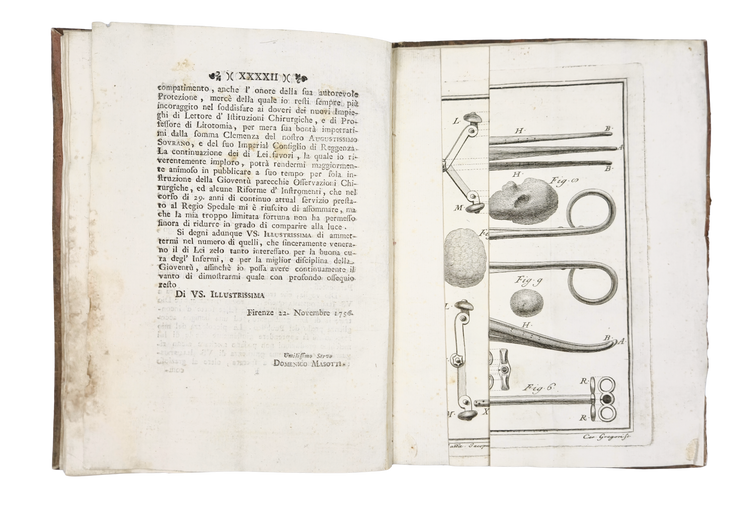
4to. XXXXII pp., with one folding engraved plate containing nine numbered figures. Complete. Title printed in red and black, with an engraved armorial vignette. The folding plate engraved by Carlo Gregori after Giovanni Battista Jacopucci. Contemporary decorative-paper boards, the covers in red and gold brocade paper patterned with flowers, scrolling foliage, grapes and hunting animals; spine covered in contrasting dark and gold patterned paper. Wide margins.
First edition of Masotti’s illustrated account of instruments designed to remove bladder stones in women without making an incision, combining mechanical invention with detailed observations of patients treated at Florence’s Hospital of Santa Maria Nuova.
Masotti taught surgery and practised lithotomy at Santa Maria Nuova. Addressed to Francesco Maggio, a Florentine patrician and senior administrator of the hospital, the work takes the form of a printed letter, dated 22 November 1756. It surveys earlier methods and instruments, discussing authorities including Celsus, Albucasis, Ambroise Paré and Girolamo Fabrizi d’Acquapendente, before setting out Masotti’s own modifications. His concern is with the practical behaviour of instruments within the body: how they open, grip and maintain a passage for the stone, and how their design might reduce injury to the patient.
Two detailed case histories record the treatment of young female patients. The first, Caterina Ippolita Compagni, was a sixteen-year-old Florentine silk weaver who had suffered symptoms for twelve years. Masotti describes her treatment in August 1756, including the need to change forceps during the operation, and reports that she regained voluntary control of urination within forty days. A second case concerns a girl of about ten from Impruneta, treated in October. These narratives connect the proposed instruments to individual patients and to the teaching environment of the hospital, where physicians, surgeons and students witnessed the procedures.
The large folding plate is integral to the argument. Nine numbered figures show the dilating and extracting instruments, their components and the stones removed from the patients; lettered details connect the mechanisms directly to the explanations in the text. The closing section discusses improvements to the ago barbeziano, the puncturing instrument associated with Paul Barbette, for draining abdominal fluid in cases of ascites. It extends the work’s concern with improving instruments beyond the treatment of bladder stones. Masotti subsequently developed his work on female lithotomy in La litotomia delle donne perfezionata (Faenza, 1763).
Masotti’s contribution is also represented by a surviving three-branched urethral dilator in the Museo per la Storia dell’Università in Pavia. The museum credits Masotti with the invention, Giovanni Alessandro Brambilla with the design and Joseph Malliard with its manufacture. Its articulated arms were intended to grasp and extract bladder stones through the female urethra without an incision, providing a material counterpart to the mechanical ingenuity documented in Masotti’s publications.
The contemporary binding is covered in striking red and gold brocade paper, its flowering scrolls and grape clusters enlivened by miniature hunting scenes with hounds, deer, a fox and a hare. Such embossed decorative papers, associated particularly with Augsburg, imitated the richness of brocaded textiles and circulated widely across eighteenth-century Europe. Here the red ornament stands out against a metallic gold ground, complemented by a contrasting patterned paper on the spine. The binding adds a distinctive example of eighteenth-century decorative printmaking to this work of surgical innovation.
Condition
A wide-margined copy retaining its striking contemporary paper binding. Some rubbing and discolouration to the decorative paper, with small losses at the spine and extremities. Faint staining to outer margin of the leaves.
References
Boffelli, Fabrizio. “Dilatatore uretrale a tre branche di Masotti – medicina e veterinaria.” Lombardia Beni Culturali, Regione Lombardia, 2008. Accessed 29 Oct. 2026.
Rusteikaitė, Ieva, et al. “A Golden Garden: Brocade Paper.” Google Arts & Culture, Vilnius University Library. Accessed 29 Oct. 2026.
Bähr, Ingeborg. “In Noble Garb—Historical Paper Bindings in the Library.” Kunsthistorisches Institut in Florenz – Max-Planck-Institut, 16 Dec. 2021.
Dondi, Raffaele Flaminio. La litotomia nella donna e il dilatatorium del chirurgo litotomo faentino Domenico Masotti (1698–1779): Spunti di storia e medicina della nostra terra. S.A.C. Stabilimento Valbonesi, 1950.
Couldn't load pickup availability
Share


Contact
Email: hugo@artemrarebooks.com
Phone: +31651042297
Visit us on appointment at:
Former US Embassy
Lange Voorhout 102
2514EJ
The Hague (The Netherlands)
Shipping address:
Nannie van Wehlstraat 51
2548MN
The Hague
The Netherlands