


Senegalese shells and their inhabitants by Marie-Thérèse Reboul
- Regular price
- €7.500,00 EUR
- Regular price
-
- Sale price
- €7.500,00 EUR
- Unit price
- per
Michel Adanson (1727–1806); Marie-Thérèse Reboul (1735–1805), illustrator and engraver.
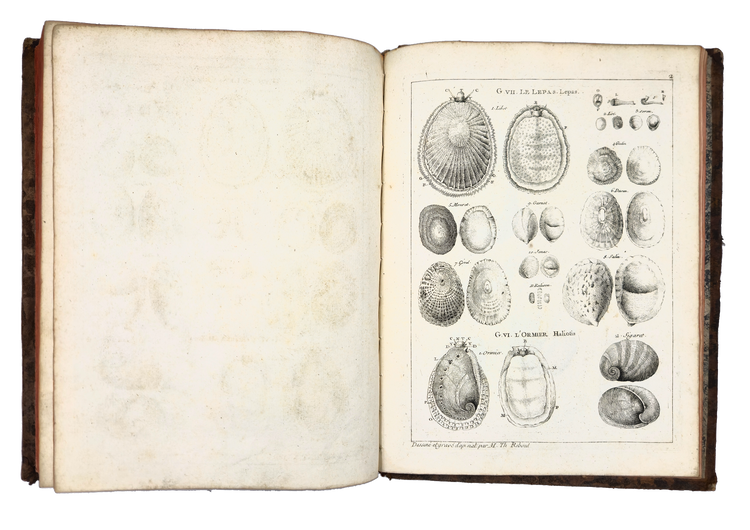
Histoire naturelle du Sénégal. Coquillages. Avec la relation abrégée d’un voyage fait en ce pays, pendant les années 1749, 50, 51, 52 & 53.
Paris, Claude-Jean-Baptiste Bauche, 1757.
4°. [8], 190, [2], XCVI, 275, [1] pp. With 19 folding engraved plates of shells and a large folding engraved map of Senegal, dated 1756.
Mottled brown sheepskin, spine with raised bands, gilt compartments and a red lettering-piece; red edges.
First edition, with nineteen Senegalese shell plates drawn and engraved by Marie-Thérèse Reboul, later known as Madame Vien. Working from specimens and Adanson’s field drawings, Reboul represented shells from several viewpoints and, in some illustrations, included the molluscs themselves. This was one of her earliest documented professional commissions.
In research presented at UCLA in 2024, Tori Champion examines these illustrations in relation to the eighteenth-century fashion for collecting shells. She places this fashion in the context of colonial exploitation, including the harvesting of shells by enslaved people. She draws particular attention to Reboul’s inclusion of the animals that made and inhabited them. These figures supported Adanson’s study of molluscan anatomy and classification, allowing readers to examine the relationship between an animal and its shell. Reboul’s contribution was therefore integral to the book’s scientific argument.
The volume appeared in the year of Reboul’s marriage to Joseph-Marie Vien and her admission to the Académie royale de peinture et de sculpture. Melissa Hyde’s 2025 reassessment restores attention to her professional ambitions and collaborations, which were subsequently obscured by her identification principally as Vien’s wife.
Adanson’s account of his observations in Senegal during 1749–1753 precedes the technical study of shells and their inhabitants. He worked there as a clerk for the Compagnie des Indes, whose West African commerce included the Atlantic slave trade. Mary Terrall’s 2023 study of his indigo experiments shows how he drew on local Wolof knowledge of indigo cultivation and dyeing, connecting Senegal with Paris and the French plantation colonies. The folding map was drawn by Philippe Buache after Adanson and engraved by Laurent.
This copy with a manuscript ownership inscription on the first free endpaper of J. Romain Pautrier, dated 1915.
Condition
Binding rubbed, with areas of surface loss and missing leather; upper headcap worn away and corners bumped. Occasional small stains and scattered spotting, some leaves a bit browned.
References
Champion, Tori. “Marie-Thérèse Reboul Vien: Finding the Natural in the Neoclassical.” Art Herstory, 13 Nov. 2021.
Champion, Tori. “Material Afterlives: The Shell Craze in Eighteenth-Century France and the Forgotten Mollusc.” Captivity: Assembling Nature’s Histories, UCLA William Andrews Clark Memorial Library, 17 May 2024. Conference abstract.
Hyde, Melissa. “Marie-Thérèse Reboul (Madame Vien): More than a Footnote in Art History.” Thinking Women and Art in the Long Eighteenth Century: Strategic Reinterpretations, edited by Mechthild Fend et al., Amsterdam UP, 2025, pp. 239–280.
Jeffares, Neil. “Vien, Mme Joseph-Marie, née Marie-Thérèse Reboul.” Dictionary of Pastellists before 1800, online ed., updated 29 Mar. 2025.
Terrall, Mary. “African Indigo in the French Atlantic: Michel Adanson’s Encounter with Senegal.” Isis, vol. 114, no. 1, 2023, pp. 2–24.
Couldn't load pickup availability
Share


Contact
Email: hugo@artemrarebooks.com
Phone: +31651042297
Visit us on appointment at:
Former US Embassy
Lange Voorhout 102
2514EJ
The Hague (The Netherlands)
Shipping address:
Nannie van Wehlstraat 51
2548MN
The Hague
The Netherlands