


Silk moiré from Valencia to Spanish America
- Regular price
- €12.000,00 EUR
- Regular price
-
- Sale price
- €12.000,00 EUR
- Unit price
- per
Joaquín Manuel Fos (1730–1789).
Instrucción metódica sobre los muerés
Madrid, Imprenta de la viuda de D. Joachín Ibarra, 1790 (colophon).
First edition. Folio (38x25 cm). [2], [1 blank], XIX, 83, [1 blank] pp. and twelve folding engravings. An engraved headpiece and initial open the introduction.
Red calf with gilt foliate borders, a gilt spine with a green lettering-piece and marbled endpapers.
Very rare first and only edition of an exceptional work on an intricate silk technique practiced in 18th century Valenica. No other copies are recorded at auction.
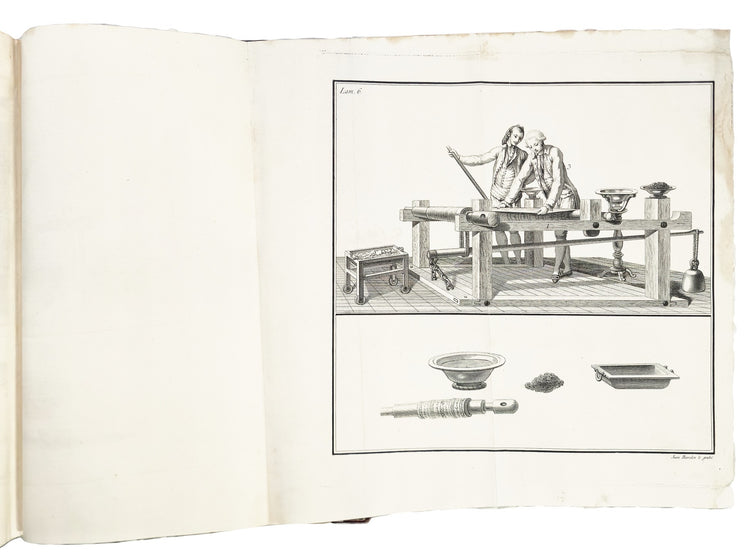
The book describes and illustrates in 12 remarkable folding plates how silk finishers gave woven cloth the rippling sheen of moiré. Valencian author Joaquín Manuel Fos explains how silk finishers used a horse-driven calender to give woven silk its rippling sheen. He describes how to build and operate the calender, wind the cloth onto the rollers and regulate the pressure, with separate instructions for preparing plain and figured silks. Plate 5 shows two women folding the silk on a trestle table and three others stitching the two layers together, rib to rib, to keep them aligned during pressing.
Spanish America became a major market for Valencian silk fabrics in the eighteenth century, as imported silks gained ground in Spain. The kingdom of Valencia produced about two-thirds of Spain’s silk thread, and its capital led the country in silk weaving. Crown protection kept weaving concentrated in the city under guild rules that made it difficult to adapt to changing fashions, while royal policy slowed the adoption of improved spinning and twisting techniques already in use in France and northern Italy. The revolutionary wars and the subsequent independence of Spain’s American colonies disrupted the transatlantic trade on which Valencian weavers had come to depend. Once the Crown authorised silk-thread exports in the nineteenth century, Valencian producers found a new market among French manufacturers and began to mechanise in the 1830s. The pebrine epidemic interrupted this recovery around mid-century (Franch Benavent and Muñoz Navarro, 2024).
The work is still relevant today. In a study of a pink silk taffeta dress attributed to the image of Nuestra Señora de las Aguas in Mexico City, textile conservators cited Fos’s explanation of the moiré finish to assess its sensitivity to moisture. Their assessment guided the choice of cleaning treatment.
Fos drew up plans and made detailed drawings to show how the machinery was used. For plain moiré, he explains how to weave the hemp cloth that covers the rollers. He recommends pressing it three or four times before gluing it to the rollers so that the weave does not mark the silk. When working a floral silk, the motifs on the two layers of cloth had to be aligned before pressing. Plate 5 shows two women folding a length of silk on a trestle table and three seated women sewing it rib to rib. Fos explains that the two layers must stay aligned to produce broad, even waves. Plate 1 gives a plan of the calender scaled in Valencian palms. Plate 3 shows the horse driving the machine, and plate 9 illustrates the transfer of the folded cloth to a roller.
Fos studied silk manufacture in Lyon. Carlos III commissioned him to establish Madrid’s first moiré factory in 1761 and he became inspector general of Valencia’s silk factories in 1777. Ester Alba Pagán and colleagues (2020) cite his improvements to moiré finishing as an example of Lyon’s influence on Valencian silk manufacture. Fos was tasked by the Junta General de Comercio to produce the present book, so that other silk finishers could use the process. Carlos III ordered the treatise printed at the Crown’s expense. The work appeared posthumously in 1790 with a dedication to Carlos IV by Pedro de Lerena, the treasury secretary. The Madrid imprint names the widow of Ibarra, Manuela Contera, who ran the press with her children.
Condition
The binding has been restored and reinforced. The red leather was rubbed, scratched and stained, with the most pronounced surface abrasion on the lower board. The corners and spine ends were worn.
The engraved title has brown marginal stains and a crease across the lower margin. The text leaves are generally clean, with occasional light spotting. The rear flyleaf is dampstained along the head and fore-edge. The folding plates show marginal dampstaining and old paper repairs at folds and edges, including a small repair to the lower outer corner of plate 6. The engraved areas remain largely clean.
References
Palau 93949.
Alba Pagán, Ester, et al. “From Silk to Digital Technologies: A Gateway to New Opportunities for Creative Industries, Traditional Crafts and Designers. The SILKNOW Case.” Sustainability, vol. 12, no. 19, 2020, article 8279, doi.org/10.3390/su12198279. mdpi.com
Bardón Iglesias, Alicia. “Instrucción metódica sobre los muerés.” The 64th New York International Antiquarian Book Fair, catalogue 232, Librería Bardón, 2024, item 42, p. 103. aba.org.uk
Franch Benavent, Ricardo. “La Real Sociedad Económica de Amigos del País y el fomento de la industria valenciana de la seda en el siglo XVIII.” Ilustración y progreso: La Real Sociedad Económica de Amigos del País de Valencia (1776–2009), edited by Nicolás Bas Martín and Manuel Portolés Sanz, Real Sociedad Económica de Amigos del País de Valencia, 2010, pp. 57–96. uv.es
Franch Benavent, Ricardo, and Daniel Muñoz Navarro. “The Golden Age of Valencian Silk? Rise, Crisis and Productive Reconversion of the Valencian Silk Industry (Eighteenth–Nineteenth Centuries).” A Global History of Silk, edited by Pierre Vernus, Manuela Martini, and Tomoko Hashino, Springer, 2024, pp. 15–36, doi.org/10.1007/978-3-031-61988-5_2. link.springer.com
Hernández Navarrete, Carlos Alberto, et al. “Restauración de un vestido del siglo XVIII atribuido a la imagen escultórica de Nuestra Señora de las Aguas.” Boletín de Monumentos Históricos, no. 45, Jan.–Apr. 2019, pp. 160–77. revistas.inah.gob.mx
Ribes Sáez, Francisco. “La comercialización de los tejidos de seda valencianos con América y sus dinámicas: Una aproximación a través de la correspondencia de la Compañía de Nuestra Señora de los Desamparados (1775–1786).” Estudis: Revista de historia moderna, no. 48, 2022, pp. 277–97, doi.org/10.7203/ERHM.48.30651. producciocientifica.uv.es
Couldn't load pickup availability
Share


Contact
Email: hugo@artemrarebooks.com
Phone: +31651042297
Visit us on appointment at:
Former US Embassy
Lange Voorhout 102
2514EJ
The Hague (The Netherlands)
Shipping address:
Nannie van Wehlstraat 51
2548MN
The Hague
The Netherlands