


The discovery of the geology of Britain
- Regular price
- €45.000,00 EUR
- Regular price
-
- Sale price
- €45.000,00 EUR
- Unit price
- per
The scientific drawings of Jean André Deluc the younger
Jean André Deluc the younger (1763–1847); after observations by Jean André Deluc the elder (1727–1817).
Collection of natural history drawings and manuscript notes.
Switzerland (?), ca. 1796–1833.
71 sheets of which 61 with drawings (pen and ink, many washed or watercoloured) and 10 with printed plates, all with handwritten captions and annotations in French, a few also in English. Some sheets signed “Deluc”. Various sizes, from c. 20.5 × 26.5 cm to 37 × 52 cm. Various types of paper, various watermarks. Some British watermarks(!).
The collection falls into three main groups:
- Geology: 27 sheets of geological sections and landscape profiles, almost all of British subjects, with long autograph notes.
- Palaeontology and zoology: 5 sheets of planetological drawings, with notes, together with 10 lithographed or engraved plates of fossil vertebrates and other specimens, with Deluc’s manuscript commentary.
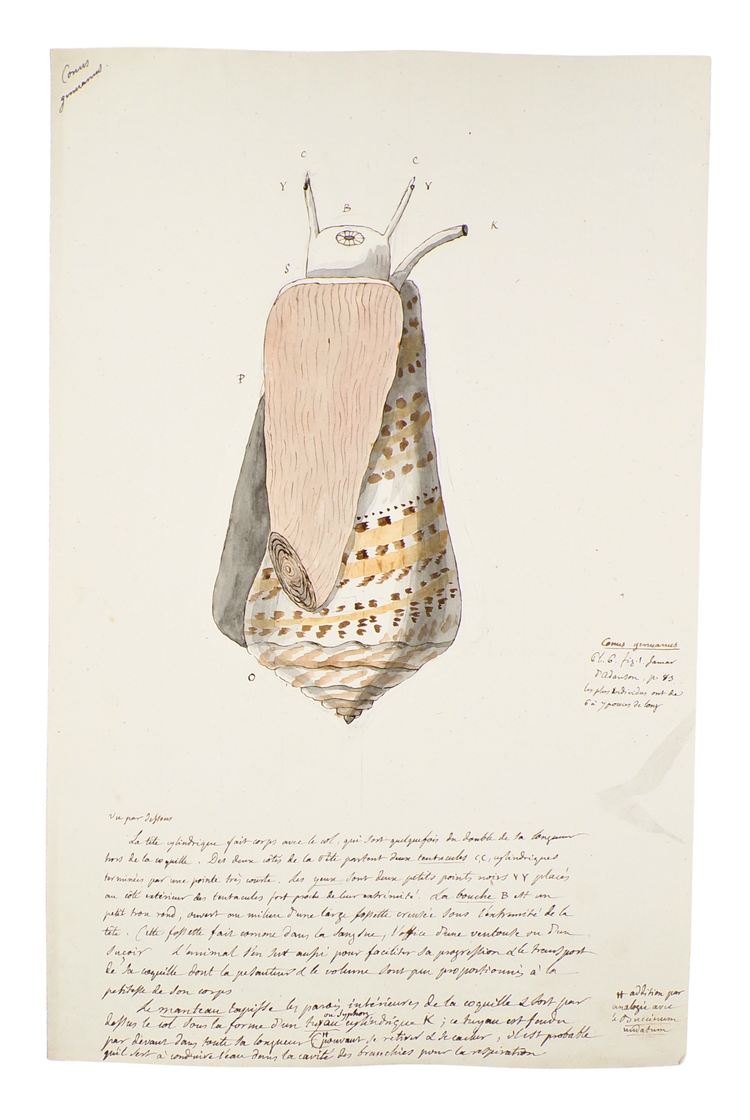
- Molluscs and marine zoology: 25 sheets of carefully finished coloured drawings of shells and other molluscs, with detailed bibliographical and taxonomic notes (some as late as 1822).
– 2 sheets of fortifications (Vauban system), one signed and dated “dessiné à Woolwich en 1799”;
– 1 sheet showing Herschel’s forty-foot telescope;
– 1 sheet with two technical drawings of a ship’s structure.
An important scientific collection by the Swiss natural historian Jean André Deluc the younger, focusing on British geology, fossils, and molluscs. The geological drawings are of exceptional interest. They are unpublished manuscript reconstructions executed by the younger Deluc on the basis of geological observations made by his cousin, Jean André Deluc the elder, during his final English fieldwork of 1796–1798.
The sheets record specific outcrops at Blackheath, Charlton and other sites around London, a long traverse from Sheffield to Castleton, parts of the Sussex coast between Cuckmere Haven and Beachy Head, and other British localities. Many bear explicit notes such as “observé en 1798” or “observations faites en 1796”, and combine landscape views with stratigraphic cross-sections and measured thicknesses. These localities do not correspond to any known published geological plates of the period, and the drawings display original analytical features—multiple views of the same ravine, corrections where earlier attempts are crossed out as “ce dessin n’est pas correct”, detailed French commentary and careful field-based dating—that show they are not copies from print but independent geological work. Interestingly, some of these sheets bear British watermarks.
A small subset of more schematic sheets (for example the idealised section of the Dudley coalfield entitled Surface of the Earth, and several didactic diagrams of folded or faulted strata) are clearly adapted from contemporary printed sources used by Deluc as teaching or reference material; one section explicitly cites Robert Bakewell’s Introduction to Geology (1815), others are derived from plates in Transactions of the Geological Society and comparable works. These theoretical sheets sit alongside the field-based drawings and show how Deluc the younger read, digested, and re-expressed the emerging geological literature.
Taken together, the geological sheets form a coherent corpus of studies that complement, and in some cases uniquely extend, the British field notes preserved in the Deluc Papers at Yale (MS 179). The Yale finding aid stresses the elder Deluc’s extensive geological travels in Switzerland, France, Italy, Germany, Spain and the British Isles (Devonshire, Wales, Birmingham, Ireland, etc.), but notes that “it is regrettable that the collection does not include more original material of this nature”. No material is recorded there for the English observations of 1796–1798 that are explicitly dated in the present collection. These sheets therefore represent a missing visual component in the documentation of the Delucs’ British geology, created when the younger Deluc re-worked his cousin’s field notes into finished diagrams.
Deluc and early British geology
Jean André Deluc the elder, a Genevan geologist and physicist, settled in England in 1773, becoming a Fellow of the Royal Society and reader to Queen Charlotte. From the 1770s through the 1790s he travelled widely across Britain, making some of the earliest systematic geological observations in the country, at a time when geology was only beginning to separate itself from natural history and antiquarian curiosity. His notebooks—partly preserved in Yale MS 179—record journeys through Birmingham, Shrewsbury and Llangollen (1788), Devonshire (two voyages, one in 1806), Belgium, Holland, Westphalia and along the Rhine, as well as extensive work in the Alps and the Jura.
These travels took place before the formal institutionalisation of geology: Hutton’s classic work at Glen Tilt dates from the mid-1780s and the Geological Society of London was founded only in 1807. Deluc’s British observations therefore belong to the very earliest phase of scientific geology in Britain. The younger Deluc, who inherited his uncle’s collections and manuscripts, continued and elaborated this research; as Henry LaFarge noted in his overview of the Yale manuscripts, the younger’s scientific papers “deal primarily with geological and palaeontological subjects” and consist largely of working manuscripts enriched by extensive bibliographical notes. The present drawings are a visual counterpart to that activity.
Other components in this collection
The mollusc drawings are meticulous studies of shells, cephalopods and other marine organisms, often larger than life and delicately coloured. Many are explicitly copied from standard works by Rumphius, Adanson and others, with the sources carefully cited (plate and figure numbers, page references) and supplemented with Deluc’s comments on classification and comparative anatomy. Two manuscript text leaves (“Mollusques divisés en dix classes” and notes from a séance of 30 March 1822 on cephalopod classification) show him engaging with early-nineteenth-century systematic zoology.
The small group of palaeontological sheets includes lithographed plates from the Transactions of the Geological Society with Deluc’s marginal notes, as well as large pen-and-ink drawings of the skeleton of a Megatherium unearthed near Buenos Aires and of bones of the giant birds Dinornis ingens and Dinornis giganteus, all with neat French descriptions. These demonstrate his interest in the new fossil vertebrates that were reshaping ideas about Earth history.
The remaining drawings document instruments and fortifications: a detailed elevation of Herschel’s forty-foot telescope, a five-bank galley “d’après le Général Melville”, and two sheets on Vauban’s first system of fortification, one annotated “dessiné à Woolwich en 1799” and inscribed “Wm Bowyer”. Together they testify to the breadth of Deluc’s technical and scientific interests.
Provenance
Swiss Deluc family; Prof. Dr Michael Jakob, Geneva (c. 2005); Erasmushaus Rare Books & Autographs, Basel (c. 2007); Aguttes, France, 2025.
Condition
Some of the larger and folding sheets show minor splits and small defects at the folds and edges; a few are lightly soiled or browned at the margins, with occasional foxing. Several leaves have been trimmed slightly short. Overall the collection is generally in very good condition, with the drawings, washes and manuscript annotations clean and legible throughout.
Literature
Henry LaFarge, “The DeLUC Manuscripts”, Yale University Library Gazette 15:2 (Oct. 1940), pp. 44–46.
Yale University Library, Manuscripts and Archives. Guide to the Jean André DeLuc Papers (MS 179). Compiled by the staff of Manuscripts and Archives, Sept. 1984.
M. J. S. Rudwick, “Jean-André de Luc and nature’s chronology”, in Geological Society Special Publications 190 (2001).
John L. Heilbron & René Sigrist (eds.), Jean-André Deluc. Historian of Earth and Man (Geneva: Slatkine, 2011).
Couldn't load pickup availability
Share


Contact
Email: hugo@artemrarebooks.com
Phone: +31651042297
Visit us on appointment at:
Former US Embassy
Lange Voorhout 102
2514EJ
The Hague (The Netherlands)
Shipping address:
Nannie van Wehlstraat 51
2548MN
The Hague
The Netherlands