


The enslaved Jean Boucaux claims his freedom – with the Code Noir
- Regular price
- €1.500,00 EUR
- Regular price
-
- Sale price
- €1.500,00 EUR
- Unit price
- per
François Gayot de Pitaval (1673–1743)
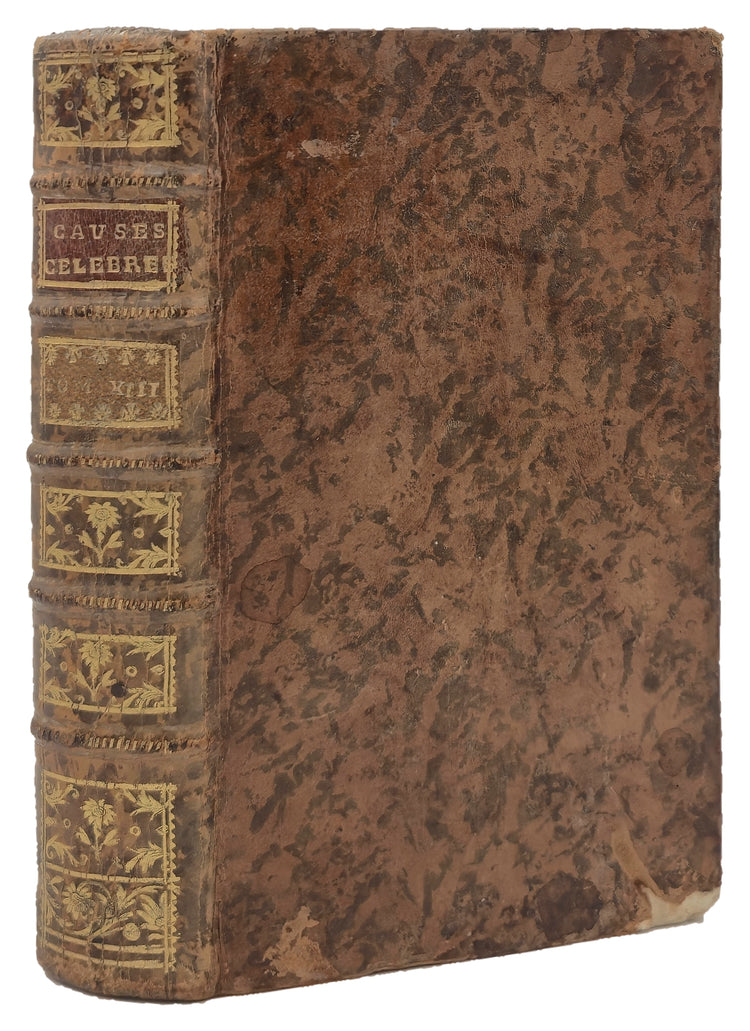
Causes célèbres et intéressantes, avec les jugemens qui les ont décidées. Recueillies par M. ***, avocat au Parlement. Tome XIII.
Paris, au Palais, chez Théodore Legras, 1747.
12°. xix, [1 blank], 616 pp. Floral ornament on the title-page.
Contemporary speckled calf with five raised bands, gilt floral compartments and gilt title and volume labels. Marbled rear pastedown.
An account of Jean Boucaux’s claim to freedom (pp. 492–586), followed by the Code Noir of March 1685, published in the thirteenth volume of Gayot de Pitaval’s collection of court cases. Brought to France from Haiti (Saint-Domingue) by Bernard Verdelin, Boucaux worked as his cook for almost ten years. After Verdelin had him imprisoned, Boucaux petitioned the Paris Admiralty Court in 1738 for his freedom and nearly a decade’s wages.
Boucaux’s lawyer Mallet argued that an enslaved person became free on reaching French soil. The case tested the effect of the 1716 edict, which allowed colonial slaveholders to bring enslaved people to France under specified conditions and which the Parlement of Paris had declined to register. The Admiralty declared Boucaux free and awarded him back pay. The King’s Council upheld his freedom but set aside the award. The Code Noir printed after the case set out the colonial rules on baptism, marriage, punishment and manumission.
On p. 586 Pitaval tells his reader why he prints the Code Noir here. Both the advocates and the Admiralty had drawn on it. The March 1685 edict occupies pp. 587–602 and ends with the record of its registration at Petit-Goâve, Saint-Domingue, on 6 May 1687. The facing page opens the letters patent of August 1685 establishing a sovereign council and four royal courts in Saint-Domingue. The October 1716 edict at issue in Boucaux’s case begins on p. 606.
Condition
Corners worn, with rubbing along the lower edges of the boards and a small patch of exposed board at the foot of the rear cover. Pale staining in the top corner margin of part of the book.
References
Peabody, Sue. “Race, Slavery, and the Law in Early Modern France.” 1994, pp. 501–510.
Peabody, Sue. “The Case of Jean Boucaux v. Verdelin.” Oxford Academic, pp. 23–40.
Couldn't load pickup availability
Share


Contact
Email: hugo@artemrarebooks.com
Phone: +31651042297
Visit us on appointment at:
Former US Embassy
Lange Voorhout 102
2514EJ
The Hague (The Netherlands)
Shipping address:
Nannie van Wehlstraat 51
2548MN
The Hague
The Netherlands