


The visual splendour of an unequal encounter; author Prince Roland Bonaparte’s copy?
- Regular price
- €4.500,00 EUR
- Regular price
-
- Sale price
- €4.500,00 EUR
- Unit price
- per
Prince Roland Bonaparte (1858–1924); Friedrich Carel Hisgen (1846-1912) [photographs].
Les Habitants de Suriname. Notes recueillies a l’exposition coloniale d’Amsterdam en 1883.
Paris, A. Quantin, 1884.
First edition.
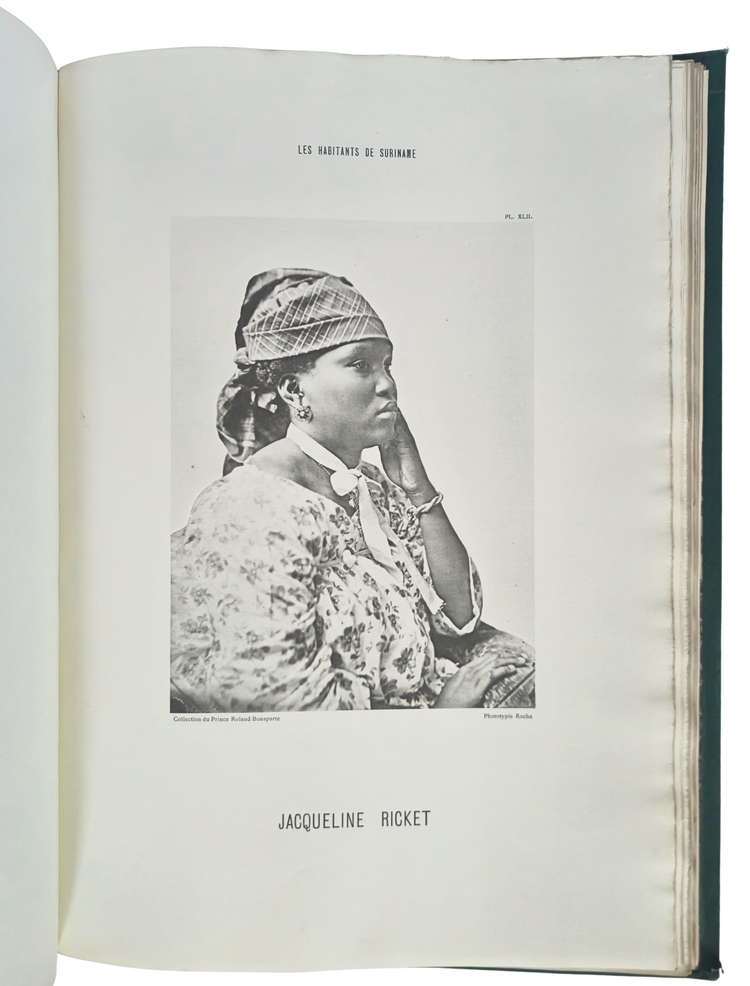
Large folio (44 x 30,8 cm). (VI), VIII, 226 pp. With a lithographed frontispiece, 2 double-page colour lithographed maps, 62 collotype portraits and some views, and 13 colour lithographic plates. The chromolithographs, based on drawings by Lewenstein, Prévost, and Libonis, depict hairstyles, ornaments, utensils, and instruments.
Original publisher’s green cloth with large gilt title on front cover and spine.
With two printed visiting cards of Prince Roland Bonaparte pasted to the front pastedown. They suggest that this copy was either retained by Bonaparte or personally presented by him. No other copy bearing two such cards has been traced, except a copy sold at Christie’s Paris in 2009 that contained a single card. Also loosely inserted is a French receipt dated 1938 for a dress worn by Princess Marie Bonaparte at a wedding. Marie was Roland Bonaparte’s only daughter.
A monumental work of colonial display and scientific racism, in which twenty-eight Surinamese men, women and children are presented in book of Imperial splendour.
Prince Roland Bonaparte’s first major anthropological publication records the group exhibited at the International Colonial and Export Exhibition in Amsterdam in 1883. Printed in a small number of copies for private distribution, it was described by Chadenat as “the most important work published in French on the anthropology and ethnography of Dutch Guiana.”
For six months the organisers displayed the group in the Surinamese Rotunda. Paying visitors observed them from behind a railing. Huts and painted panoramas created the illusion of a Surinamese settlement, although the participants were housed at night in a wooden building nearby. The display presented a carefully staged image of the colony intended to promote Dutch commercial interest in Suriname.
The group included Kali’na and Lokono people, members of the Saamaka and Ndyuka Maroon communities, and Afro-Surinamese residents of Paramaribo. Their recruitment took place within profoundly unequal colonial circumstances. Surviving evidence does not establish the degree of consent involved. Accounts of persuasion and promises, together with the presence of several children, nevertheless complicate any suggestion of wholly voluntary participation. Individual motives also differed. Kwamina Baja chose to travel despite his family’s opposition. During the exhibition Colhee, an Indigenous participant, died from a pulmonary illness and was buried in Amsterdam.
The Amsterdam photographer Friedrich Carel Hisgen photographed the participants in paired frontal and profile views. He also made group portraits and views of the staged settlement. Roche reproduced the images as finely executed collotypes. Bonaparte arranged the volume according to contemporary racial classifications and subjected the sitters to anthropometric examination based on Paul Broca’s methods. Their bodies were measured and converted into comparative racial “types”. The photographs are therefore inseparable from the history of colonial anthropology and scientific racism.
The book nevertheless records names, ages, places of origin, occupations, languages, education and family relationships. These details allow many of the sitters to be recognized as individuals, although their histories remain mediated through Bonaparte and his informants. The tension between individual biography and racial categorization lies at the centre of the volume.
Its monumental format, rich colour printing and accomplished photography gave visual splendour and scholarly authority to knowledge produced through a profoundly unequal encounter. The volume is at once a magnificent example of nineteenth-century book production, an important source for Surinamese history and a material expression of colonial power.
Condition: binding very slightly rubbed. One plate with a small marginal tear. One text leaf detached without loss. Otherwise a fine copy.
Provenance: Bibliothèque S.M.E., Quebec, with repeated cancelled ink stamps.
Reference: Chadenat, I, no. 765.
Further reading:
Helen Wijngaarde, “Curiositeit of Cultuurdrager. Surinamers op de Internationale Koloniale en Uitvoerhandel Tentoonstelling te Amsterdam in 1883,” OSO, volume 19, no. 2, 2000.
Carl Haarnack, “Les Habitants de Suriname,” Bibliotheca Surinamica.
Couldn't load pickup availability
Share


Contact
Email: hugo@artemrarebooks.com
Phone: +31651042297
Visit us on appointment at:
Former US Embassy
Lange Voorhout 102
2514EJ
The Hague (The Netherlands)
Shipping address:
Nannie van Wehlstraat 51
2548MN
The Hague
The Netherlands